


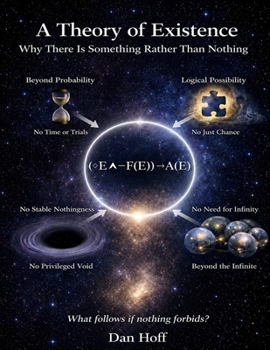
A Theory of Existence: Why There Is Something Rather Than Nothing

Why is there something rather than nothing?
It is one of the oldest questions in philosophy-and perhaps the most fundamental. Yet most proposed answers begin by assuming that something already exists: physical laws, matter, mathematics, consciousness, information, God, or some other underlying reality.
A Theory of Existence begins one step earlier.
Rather than asking what caused existence, Dan Hoff examines whether existence requires a cause at all. The book approaches the problem through logical admissibility and prohibition, asking whether absolute nothingness can truly be treated as the natural default.
At the center of the argument is a simple possibility: if structured existence is logically admissible and no ultimate principle prohibits it, what would permanently prevent it from obtaining?
From this starting point, the book explores the asymmetry between existence and nothingness, the difference between possibility and probability, the limits of causal explanation, and the point at which conventional explanations may themselves presuppose the very structure they are attempting to explain.
The argument is deliberately ontologically neutral. It does not require the reader to begin with materialism, idealism, theology, simulation theory, information ontology, or any particular theory of ultimate reality.
A Theory of Existence does not claim to explain what reality is ultimately made of or how our physical universe began. It addresses a more foundational question:
Before we ask what reality is, should we first ask why reality is possible at all?
Related Subjects
PhilosophyCustomer Reviews
ThriftBooks ® and the ThriftBooks ® logo are registered trademarks of Thrift Books Global, LLC
