


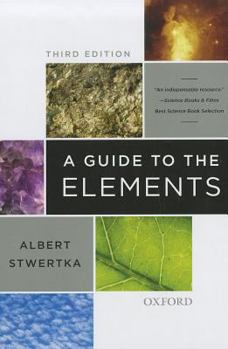
A Guide to the Elements

Select Format
Select Condition 
Book Overview
Newly updated throughout, and now covering 118 elements, this crystal-clear guide to the periodic table illuminates the basic concepts of chemistry as it traces the history and development of our knowledge of the material world. In this fascinating volume, Albert Stwertka makes complex ideas and terms easily understandable, drawing upon engaging historical anecdotes and everyday examples to clarify the text, which is complemented by numerous illustrations, many in full color. Since the second edition, many new elements have been named and discovered, including Darmstadtium, Roentgenium, and Copernicium, and the elements currently called Ununtrium, Ununpentium, Ununhexium, Ununseptium, and Ununoctium. The third edition provides thorough coverage of all these new discoveries. In addition to the new elements, Stwertka has brought the information about the elements in the second edition up-to-date, based on the latest research. He discusses a cylindrical molecule of carbon known as a "nanotube," which has become a do-all wonder substance, touted for use in everything from X-ray machines to paint. A new form of the element boron has been found that is nearly as hard as diamond. Its superior heat resistance could make it attractive for certain industrial uses. And a new particle detector using ultra-pure liquid xenon has been constructed beneath 5,000 feet of rock in Italy to detect dark matter. Stwertka also covers the 2010 Nobel-winning work on graphene, an ultrathin form of carbon that is vital for future generations of computers and touch screens, the discovery of new superconductors, and the development of new uses for the rare earth elements. Bringing the periodic table into the 21st century, this engrossing guide to the elements will fascinate everyone curious about the basic building blocks of the material world.
Format:Hardcover
Language:English
ISBN:019983251X
ISBN13:9780199832514
Release Date:February 2012
Publisher:Oxford University Press, Incorporated
Length:256 Pages
Weight:1.95 lbs.
Dimensions:0.9" x 7.1" x 10.1"
Age Range:13 to 17 years
Grade Range:Grades 8 to 12
Customer Reviews
5 ratings
The fun introduction to elements
Published by Thriftbooks.com User , 18 years ago
Lets be honest. For starters in chemistry, learning about all the elements and what they do in reactions can be overwhelming with all the pressure for doing well in school. What better way to learn about elements than a fun and leisurely reading. This book is packed with information about almost all of the elements, the more important elements obviously getting more extensive treatment. Reading this book before you take your school or college chemistry will be the most rewarding experience. Not only will it make you appreciate the nature of each element that exists in our universe but also make you sound like a genius when you and your friends are talking about even the most common elements such as oxygen or hydrogen. Oh, there are lots of cool photos and pictures too!
For the curious mind
Published by Thriftbooks.com User , 20 years ago
For the armchair science enthusiast, we have an outstanding book explaining the elements of the periodic table, and their signifigance. Its one of those books, when opened at random, provides fascinating reading wherever you start. In this fine book, learn about the periodic table and its components, how they relate, and how they are utilized in modern technology and industry.
A perfect small guide to chemistry for a student or layman
Published by Thriftbooks.com User , 23 years ago
There are at least 112 chemical elements, all of which but a few comprise the entire world as we know it. This book covers each element seperately, in order, from hydrogen to the various transuranium elemnts that only exist for mere seconds in laboratories. Each element's atomic weight, valence(s), and various uses are given. Also given is the human history of each element, including its discovery and the origin of its name. I suspect that any reader, outside of a chemistry instructor, perhaps, will learn something from this endlessly fascinating, well- written and organized book. Many general principles of chemistry rub off as well, and for the student or interested layman, this is a highly useful, easily readable, and understandable book about chemistry. A true jewel, and I rate it highly.
A great informational book
Published by Thriftbooks.com User , 25 years ago
I love chemistry and the elements, and this book didn't let me down. It is very interesting to ready and covers most areas about each of the compounds. It also lists the major uses and even some of the health problems associated with the elements. The pictures are also very good. The pictures represent the elements themselves or the uses of the elements. This helps a lot. There are only two small things I don't like about the book. First, it doesn't give much basic information. I would recommend "Exploring Chemical Elements and their Compounds" by David L. Heiserman. The two books together create a treasure trove of information. The other problem is just a small one. The author focues a lot on the uses in radioactive procedures. I guess that doesn't interest me too much. Otherwise this is a great book! I would suggest you get this book for personal use or even for schooling purposes.
A Guide to the Elements
Published by Thriftbooks.com User , 26 years ago
A Guide to the Elements by Albert Stwertka is an excellent source of information about the history, origin of name, and important/interesting uses of the elements up to atomic number 112. A chronology of the discovery of the elements and many contemporary as well as historical illustrations enhance the information in the text. Information about physical and chemical properties is not included. An excellent companion for the chemistry classroom is Exploring Chemical Elements and their Compounds by David L. Heiserman which has information about chemical and physical properties as well as abundance, allotropes, and isotopes.
Copyright © 2026 Thriftbooks.com
Terms of Use | Privacy Policy | Do Not Sell/Share My Personal Information | Cookie Notice | Cookie Preferences | Accessibility Statement
ThriftBooks ® and the ThriftBooks ® logo are registered trademarks of Thrift Books Global, LLC
ThriftBooks ® and the ThriftBooks ® logo are registered trademarks of Thrift Books Global, LLC
