
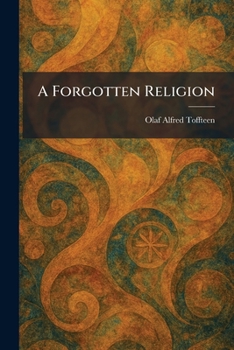
"A Forgotten Religion" is a profound scholarly investigation into the spiritual landscapes of antiquity, focusing on the complex religious systems that shaped early human civilization. Written by Olaf A. Toffteen, an expert in Semitic languages and history, this work meticulously examines the origins, development, and eventual decline of ancient belief systems that have since faded into obscurity. The text delves into the transition from primitive worship to the structured mythologies and theological frameworks of the ancient Near East, providing a vital bridge between archaeology and religious studies.
Through a rigorous analysis of historical records and linguistic patterns, the work reconstructs the worldviews of ancient peoples, offering insights into their rituals, deities, and cultural values. Toffteen explores how these forgotten traditions influenced later monotheistic religions and the broader evolution of human spirituality. The study serves as an essential resource for readers interested in comparative religion, ancient history, and the origins of Semitic culture. By illuminating the historical forces that defined these early legacies, "A Forgotten Religion" highlights the enduring human quest for meaning and the historical preservation of sacred knowledge.
This work has been selected by scholars as being culturally important, and is part of the knowledge base of civilization as we know it. This work was reproduced from the original artifact, and remains as true to the original work as possible. Therefore, you may see the original copyright references, library stamps (as most of these works have been housed in our most important libraries around the world), and other notations in the work.
This work is in the public domain in the United States of America, and possibly other nations. Within the United States, you may freely copy and distribute this work, as no entity (individual or corporate) has a copyright on the body of the work.
As a reproduction of a historical artifact, this work may contain missing or blurred pages, poor pictures, errant marks, etc. Scholars believe, and we concur, that this work is important enough to be preserved, reproduced, and made generally available to the public. We appreciate your support of the preservation process, and thank you for being an important part of keeping this knowledge alive and relevant.

