


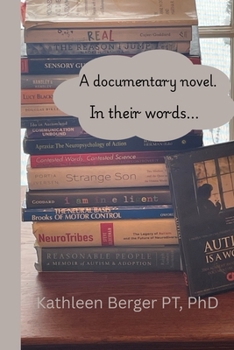
A Documentary Novel: In Their Words...

Approximately 30% of children diagnosed with autism are non or minimally able to speak words. Historically, these children were institutionalized, heavily medicated, or both. Kathleen worked with these children in the school system when her son, Kris, was born. When Kris was first diagnosed with autism and didn't speak (he only spoke two words in his life), Kathleen grieved. But then she learned about the communication strategy called Facilitated Communication Training(FCT) and Kris ended up communicating with her withthis method It gave her great hope for his future, but they never got that chance - Kris died three months later.
Facilitated Communication is one method that falls under the umbrella of supported typing and numerous individuals with autism have become independent, even reading their words after initially using physical support of resistance or touch to their arm or hand. At the same time people with autism and their families were finding hope and success with communication, studies revealed that there could be influence when using the supports. Some professionals took this to mean there was no true communication and many professional organizations, in response to these studies, have largely stated this is a discredited technique that should not be used.
Not irrelevant here, there were instances of people being accused of child abuse by typers when using physical support. Because of the possibility for influence, this fueled thefire for detractors and the discussion turned vitriolic. As Kathleen had experienced clear intentional movement using the FCT technique with her son, and later many others, she never discounted that communication with supported typing was true but also acknowledged the possibility for influence. Primary questions raised by these supported typing strategies include 1) how could someone learn to read without being formally taught? 2) If there is true communication coming from the typer, why is there so much influence when participating in the double blind studies? 3) How do the movement differences seen in autistic persons present and does it parallel the brain differences we see?
Kathleen uses a fiction venue to illustrate specifics with supported typing while interjecting expert opinion vignettes to address the controversies. Scientific, autobiographical and clinical reports are integrated to give the reader an understanding for things like the unique way dyspraxia presents in autism, and why both the influence and true communication from users makes sense.
Supported typing has been life-changing for many people with autism and their families, yet supported typing is not accepted in schools or many therapy clinics and studies examining optimal implementation are limited in funding resources, Kathleen believes this is in large part to a lack of understanding and hopes this will shed some light on the topic .
Customer Reviews
ThriftBooks ® and the ThriftBooks ® logo are registered trademarks of Thrift Books Global, LLC
