


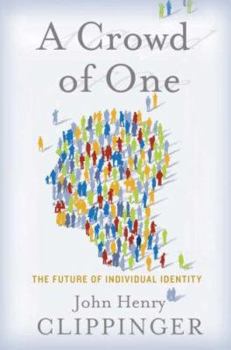
A Crowd of One: The Future of Individual Identity

Great leaps forward in scientific understanding have, throughout history, engendered similar leaps forward in how we understand ourselves. Now, the new hybrid disciplines of evolutionary biology and... This description may be from another edition of this product.
Format:Hardcover
Language:English
ISBN:1586483676
ISBN13:9781586483678
Release Date:April 2007
Publisher:PublicAffairs
Length:240 Pages
Weight:1.02 lbs.
Dimensions:9.5" x 0.8" x 6.5"
Customer Reviews
5 ratings
A Revolutionary Book, period
Published by Thriftbooks.com User , 17 years ago
As jumbled as it is, this is a devilishly good and interesting book. Because of the rather haphazard organization, one has to read it twice, first from front to back and then in reverse to get the full impact of the substance and the author's main points, which are that: There are systemic forces controlling man's social universe, his "social (and emotional) physics" as he has coined it here. These forces, like Adam Smith's "invisible hand," more often than not, lie hidden in the subtext of society, in the background and to a larger extent than either scientists or lay people are willing to admit, have evolutionary, value, connections and consequences. "Dawkins and his fellow Soicobiology compatriots" were wrong in suggesting that evolution is only about "individual selfishness," as in Dawkins' "The Selfish Gene." New convincing scientific evidence from the Evolutionary Scientists (Biologists and Social Psychologists) and Neurobiologists proves that some of man's most basic emotional behaviors have evolved precisely because they too have survival value, and have been "selected for" in the same way as many of our physical components have been. [And Here for the first time I had confirmed in print my own long held suspicion that social and cultural evolutionary changes occur light years ahead of any biological ones.] Clippinger's main thesis is that these emotional changes too have been honed and shaped by over 200,000 years of evolutionary specialization, and that if we take heed of them and new findings involving them, as well as their consequences, we can revolutionize our closed, hierarchical, theocratic and still violently traditional societies into open, dynamic, self-directed, and self-sustaining societies. It is a very appealing thesis with more than just face validity. While democracies, free-markets, and even the Western cultural order itself with its bloated dependence on military power, are just mere cultural artifacts that will pass in due course, the "invisible social physics" that underlie them, are systemic and universal in their nature, convey evolutionary advantages and will endure: That is to say, they are evolutionarily stable strategies (to use another of Clippinger's beautifully coined phrases) and can serve as a platform for reorganizing humanity in fundamentally new ways. The author's overall point is that what we need to be colonizing is not the artifacts of cultures, or the old feudal paradigms of past civilizations, and certainly not increasing reliance on weapons, which are becoming obsolete in a world that relies more and more on networking and C^2; or even on what was once thought to also convey evolutionary advantages -- competitive and aggressive behaviors -- but instead, we must rely more and more on these larger more human and curiously more "universal emotional systemic forces" that much to our scientific surprise we are discovering have evolved precisely to extend our survival. These are serious poi
Hello Us
Published by Thriftbooks.com User , 17 years ago
Clippinger makes a reasonable argument for the social component of evolution and the future of humanity. He clearly illustrates the differences in the Darwinian view of individual fitness and the more recent view of community success. Successful individuals are the result many times of successful communities and the influences of those communities. In having recently delved deeper into Ayn Rand and her dissertations on reason and ego, I found that the idea of mutual self-interest rang more true to me. Lone wolves are not the stuff of societal success. Community-based reasoning is often the more successful approach as seen in the Renaissance, the Enlightenment and the founding of our own country. Clippinger's presentation and its specific analysis of historical precedent is cognitive of today's advances and helped highlight to me that perhaps we are on the edge of another such moment in time. Although he touched briefly on terrorism and its community-oriented motivations AND he touched on the benefits of large-scale collaboration, I would have liked to have seen a bit more analysis into how today's collaboration and digital community building is being addressed as a potential security threat to large corporations, countries or any large-scale entity. In the past, outlier assaults were the stuff of only a few minds. Today, massive coordination can occur that could also lead to ideas and horrible "successes" that are bigger than any one member of the offending group. I don't believe all crowds of one are necessarily going to be beneficial or benign... Great read.
College-level libraries strong in social issues will find this a fine discussion
Published by Thriftbooks.com User , 18 years ago
A CROWD OF ONE: THE FUTURE OF INDIVIDUAL IDENTITY surveys the history and culture of the individual, examining biological identity, how social functions and emotions translate between individuals, and how humans discover both individual identity and common, shared purpose in communities. College-level libraries strong in social issues will find this a fine discussion of how cultural issues are approached and how the history of human progress is one of seeking and making connections - and how these have evolved over time. Diane C. Donovan California Bookwatch
Great book about Social Behavior
Published by Thriftbooks.com User , 18 years ago
John Clippinger's book "A Crowd of One" is a great contribution to bridge the gap between the natural and the human/social sciences on the example on social behavior. He tells us how science helps to understand the principles of individual decisions, identity, networks and social behavior, and how they drive trust, altruism, collaboration and leadership. He illustrates this on actual topics like the war in Iraq and virtual worlds as Second Life. The book is easy to read and to understand.
Major leap forward in understanding humanity and its future
Published by Thriftbooks.com User , 18 years ago
As a long-time admirer of Kuhn's concepts on paradigms and how they shift ("The Structure of Scientific Revolution" I really appreciate any thought leader that puts us on the cusp of such a shift. John Henry Clippinger is there. I will begin with his conclusion: we are in the process of a "Big Bang" in human identity that shifts us away from organizations and nationalities and races and religions, and toward the realization that we are all "one" in terms of fractional variations of the same DNA, and hence, the world is going to start to revolve around the human end-users, not the organizations that turned them into slaves, amoral components of the industrial system, or mindless fundamentalists party to intolerant religions. For a sense of how the industrial era introduced evil by killing the role of kinship in trust, see Lionel Tiger's "The Manufacture of Evil." In my view, this is one of three really great books on the coming revolution in human organization. The other two are Max Manwaring's "The Search for Security" and Philip Alott's "The Health of Nations." As Alott says, we took a wrong turn at the Treaty of Westphalia, and the world is long over-due for a return to localized kinship and global responsibility. Those who favor the transpartisan transformational model of earnest and honest elections and engaged citizenry must read this book. The author opens with a long discussion of why it is relationships that matter, not transactions. Indeed, I am reminded of Margaret Wheatley and Esther Dyson--make the connections, don't worry about critical mass. I learn the term "social physics" for the first time, and read again about reciprocity (Tom Atlee taught me about reciprocal altruism). The author disputes the idea that violence is a given, and joins Jonathan Schell ("The Unconquerable World") is stating that force is no longer a means by which to gain one's will. The middle of the book discusses both the threat of technical progress when combined with more failed states, and the promise of digital modeling for accelerating our understanding and testing new paths forward. The author points out that we have no more than 20 years, having wasted the last six, with 2000-2025 being the tipping point period during which we can either go toward stable convergence or hyper-instability and cascading catastrophe. Brilliant quotes on how the military must shift to soft preventive and remedial measures (General Al Gray, USMC and I called this "peaceful preventive measures in 1988), and how "Brute force is about to be rendered obsolete" at the state level (while flourishing at the gang level). The author relates his thinking to terrorism in a very useful way, conceptualizing terrorism as a form of non-state parasite eating away at its host, and able to be more entrepreneurial than its bureaucratic adversaries, constantly changing the rules of engagement and winning the key terrain of the minds of the population, using perception in lieu of truth. T
Copyright © 2026 Thriftbooks.com Terms of Use
| Privacy Policy | Do Not
Sell/Share My Personal Information | Cookie Policy | Cookie Preferences | Accessibility Statement
ThriftBooks® and the ThriftBooks® logo are registered trademarks of Thrift Books Global, LLC
ThriftBooks® and the ThriftBooks® logo are registered trademarks of Thrift Books Global, LLC
