


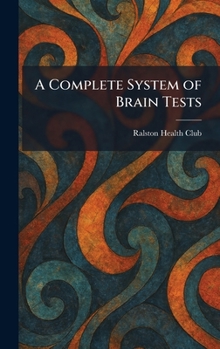
A Complete System of Brain Tests

"A Complete System of Brain Tests" offers a comprehensive and fascinating guide to measuring and developing the various faculties of the human mind. Developed by the influential Ralston Health Club, this work provides a structured series of examinations and challenges designed to evaluate cognitive abilities such as memory, logic, concentration, and creative synthesis.
The text serves as a practical manual for those seeking to understand the inner workings of their intellect and improve their mental performance through disciplined practice. It reflects a significant period in the history of self-help and psychological study, emphasizing the belief that the brain can be strengthened and refined through specific, targeted exercises. By categorizing different types of intelligence and providing the tools to measure them, the work aims to help individuals identify their strengths and address their weaknesses.
This volume is a valuable resource for those interested in the history of psychometrics, the New Thought movement, and the early 20th-century approach to personal mastery. "A Complete System of Brain Tests" remains a compelling exploration of human potential and the effort to cultivate a sharper, more effective mind through dedication and systematic testing.
This work has been selected by scholars as being culturally important, and is part of the knowledge base of civilization as we know it. This work was reproduced from the original artifact, and remains as true to the original work as possible. Therefore, you may see the original copyright references, library stamps (as most of these works have been housed in our most important libraries around the world), and other notations in the work.
This work is in the public domain in the United States of America, and possibly other nations. Within the United States, you may freely copy and distribute this work, as no entity (individual or corporate) has a copyright on the body of the work.
As a reproduction of a historical artifact, this work may contain missing or blurred pages, poor pictures, errant marks, etc. Scholars believe, and we concur, that this work is important enough to be preserved, reproduced, and made generally available to the public. We appreciate your support of the preservation process, and thank you for being an important part of keeping this knowledge alive and relevant.
Customer Reviews
ThriftBooks ® and the ThriftBooks ® logo are registered trademarks of Thrift Books Global, LLC
