


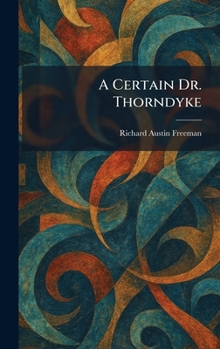
A Certain Dr. Thorndyke

"A Certain Dr. Thorndyke" is a compelling mystery novel by R. Austin Freeman, featuring his most famous creation, the astute medical-legal expert Dr. John Thorndyke. The narrative masterfully weaves together two seemingly disparate threads: a daring jewel robbery in London and a high-stakes adventure set against the backdrop of the African Gold Coast. As the plot unfolds, these paths converge, drawing the analytical Dr. Thorndyke into a complex web involving hidden identities and professional intrigue.
Freeman, a pioneer of the scientific detective story, showcases his deep knowledge of medical jurisprudence and analytical observation throughout the work. Unlike many of his contemporaries, Dr. Thorndyke relies on rigorous scientific methods, utilizing microscopes and chemical analysis to uncover the truth. The story transitions from a tale of colonial adventure to a sophisticated masterclass in forensic deduction, highlighting the intellectual rigor that defined the Golden Age of crime fiction.
"A Certain Dr. Thorndyke" remains a significant work in the evolution of the genre, capturing the transition from traditional mystery to the modern procedural. It offers readers a sophisticated blend of suspense, exotic locales, and logical problem-solving, cementing its status as an essential read for enthusiasts of classic British mysteries and early forensic science in literature.
This work has been selected by scholars as being culturally important, and is part of the knowledge base of civilization as we know it. This work was reproduced from the original artifact, and remains as true to the original work as possible. Therefore, you may see the original copyright references, library stamps (as most of these works have been housed in our most important libraries around the world), and other notations in the work.
This work is in the public domain in the United States of America, and possibly other nations. Within the United States, you may freely copy and distribute this work, as no entity (individual or corporate) has a copyright on the body of the work.
As a reproduction of a historical artifact, this work may contain missing or blurred pages, poor pictures, errant marks, etc. Scholars believe, and we concur, that this work is important enough to be preserved, reproduced, and made generally available to the public. We appreciate your support of the preservation process, and thank you for being an important part of keeping this knowledge alive and relevant.
Customer Reviews
ThriftBooks ® and the ThriftBooks ® logo are registered trademarks of Thrift Books Global, LLC
