


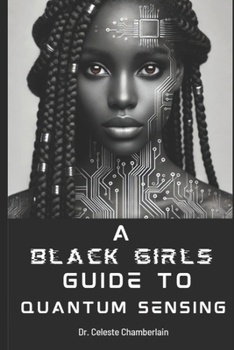
A Black Girls Guide to Quantum Sensing

Some machines can now feel a tunnel through solid ground, read a heartbeat through a wall, and find their way home with the satellites switched off. This is the book that finally explains how.
It is called quantum sensing. It is not science fiction and it is not fifty years away. It is being tested in the air, under the ocean, and in orbit right now, and it is quietly moving into medicine, policing, borders, climate, defense, and your own body. Almost nobody has bothered to explain it to you.
Your Tech Auntie is about to fix that.
No physics background. No dumbing down. Across twenty chapters you learn the real science through stories and plain language: the deliberate flaw in a diamond that lets it sense a single heartbeat, the atom dropped through a vacuum chamber to weigh the ground beneath it, the clock so exact it can feel the difference in gravity between your head and your feet.
Then it asks the question most technology books skip. Who is this really for?
Every powerful new way of measuring the world gets pointed somewhere, and history is clear about where it tends to get pointed first. You will look hard at surveillance, the measurable border, the fight for environmental proof in fence-line communities, and the last private place there is, which is the inside of your own body. You get the wonder and the warning, every time, in both hands.
You will also meet the women who were always here. Dr. Gladys West, whose mathematics of the earth's true shape sits underneath the blue dot on your phone. Willie Hobbs Moore, the first African American woman in this country to earn a physics doctorate, who was doing precision measurement before it had a friendly name. Katherine Johnson, Dr. Shirley Ann Jackson, Dr. Alondra Nelson, Sharon Lavigne, and the scientists building this field today.
And then it hands you the door. The entire global quantum industry is roughly the size of a small town. More than half of its job postings ask for a bachelor's degree or less. There are ten-week programs with no math prerequisites whose graduates get hired. One of the field's lead technicians used to decorate cakes in a supermarket. This room is not closed. Nobody told you the door was open.
The book moves in four parts: how the sensors work, how they became invisible infrastructure, who pays the price when precision arrives, and what you can actually do about it.
Inside you will find:
Atomic clocks, magnetometers, gravimeters, diamond sensors, and Rydberg receivers, explained in plain EnglishHow nations navigate, hunt submarines, and see underground when GPS goes darkWhat this technology means for policing, immigration, climate proof, privacy, and your medical careWhere the money, the laws, and the jobs actually areHow to read a breathless headline and tell the real from the soldTech Auntie Takeaways closing every chapter, so nothing important slips awayAnd every fact is sourced. More than 130 bottom-of-page citations, current through 2026.
Written for the girl who takes things apart to see what is inside, the woman tired of being talked around instead of talked to, and anyone who was told a room was too complicated for them and always suspected that was a lie. It makes a real gift for a curious student, a career changer, or the person in your life who keeps asking the good questions.
Stay curious. Stay awake. Be in the room when they decide what gets measured.
Customer Reviews
ThriftBooks ® and the ThriftBooks ® logo are registered trademarks of Thrift Books Global, LLC
