


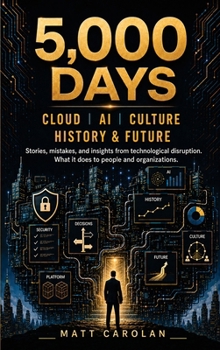
5000 Days: Cloud, Ai, Culture, History & Future

TECHNOLOGY CHANGES FAST. PEOPLE AND ORGANIZATIONS DON'T.
At 2 a.m. on a Saturday in 2005, Matt Carolan was sleeping on a commercial office floor, using foam packaging from an IBM server box as a pillow while waiting for files to copy before Monday morning.
Five years later, he launched a Windows server in the cloud and had it running in less than ten minutes.
That transformation was enormous. But the technology was only part of the story.
The real challenge was how people and organizations adapted to it.
5,000 DAYS OF CHANGE
5,000 Days looks back at roughly 5,000 working days of technological disruption to understand what happens when technology changes faster than the people, businesses, cultures, and institutions expected to use it.
Cloud computing shaped the last 5,000 days. Artificial intelligence, automation, quantum computing, energy constraints, and technologies we have not yet imagined will shape the next.
This is not a technical manual, certification guide, or sales pitch.
It is a collection of real-world stories, mistakes, lessons, and uncomfortable questions about how disruption changes businesses, careers, cultures, and people.
THE TECHNOLOGY IS USUALLY THE EASY PART
Drawing on experience with startups, governments, and global enterprises, Carolan explores why transformation so often succeeds or fails for reasons that have little to do with the technology itself.
Trust. Fear. Incentives. Politics. Leadership. Ownership. Cost. Culture. And the uncomfortable realization that yesterday's expertise may not be enough for tomorrow.
The cloud revolution provides the case study. It changed how organizations build, secure, fund, and operate technology. But its biggest lessons were human.
The book examines cloud economics, security, identity, FinOps, accountability, and the different philosophies behind AWS, Microsoft Azure, and Google Cloud, not simply to explain cloud, but to show what happens when established ways of working collide with disruptive technology.
NOW AI IS DOING IT AGAIN
Artificial intelligence is accelerating the cycle.
AI will reshape jobs, creativity, decision-making, professional expertise, leadership, and the relationship between humans and machines. It will also create new problems involving bias, privacy, trust, accountability, misinformation, and systems that can sound confident while being completely wrong.
AI will not wait for every individual, company, or regulator to feel ready.
And AI will not be the last disruption.
THE NEXT 5,000 DAYS
Looking forward, 5,000 Days considers a world where AI becomes part of how work is performed, cloud fades into invisible infrastructure, computing competes for energy, quantum technology begins changing security and optimization, and entire careers are reshaped.
But the central question remains the same:
How do we adapt when the world changes faster than we do?
The final chapter turns the lens on the reader, exploring personal and organizational technology change styles and why friction appears when people and organizations move at different speeds.
Written with humor, honesty, and the perspective of someone who lived through one major technology revolution and is watching the next begin, 5,000 Days is for anyone trying to understand not only where technology is going, but how to remain useful, adaptable, responsible, and human while it gets there.
Technology changes quickly.
People change when they are ready.
The question is whether the future will wait.
Customer Reviews
ThriftBooks ® and the ThriftBooks ® logo are registered trademarks of Thrift Books Global, LLC
