


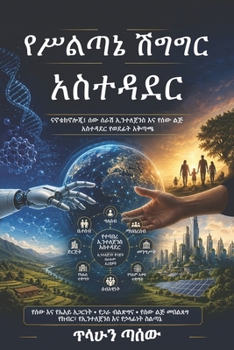
የሥልጣኔ ሽግግር አስተዳደር: ናኖቴክኖሎ [Afrikaans]
No Customer Reviews

For more than half a century, my professional work as a management consultant, researcher, and author has been guided by a single question:
How should humanity organize itself to achieve sustainable progress?
As my research continued, however, it became increasingly clear that the challenges created by artificial intelligence, robotics, nanotechnology, biotechnology, quantum technologies, and advanced digital networks extend far beyond organizational management.
Humanity is entering a new stage of civilization.
The fundamental question is therefore no longer simply:
"How should organizations govern artificial intelligence?"
It has become a far larger question:
"How should humanity govern an Intelligence Civilization?"
This book represents my attempt to answer that question.
Rather than treating artificial intelligence as an isolated technological development, it views the present transformation as part of a broader historical process comparable to the Agricultural Revolution and the Industrial Revolution.
Every great technological revolution has required a corresponding revolution in governance.
The Intelligence Revolution is no exception.
The book proposes a Federated Intelligence Governance Model in which governance begins with the individual and the family, extends through communities, enterprises, municipalities, nation-states, regional institutions, and the United Nations system, and ultimately supports the coordinated governance of humanity itself.
The objective is not centralized world government.
It is intelligently coordinated human civilization.
One of the book's most significant contributions is the Declaration for the Intelligence Civilization.
The Declaration is presented not as a political manifesto, but as a statement of shared principles intended to guide humanity through one of the greatest transitions in its history. It affirms that technological progress should always remain subordinate to human dignity, ethical responsibility, democratic participation, peace, justice, sustainability, and the flourishing of all people.
If the Industrial Revolution gave humanity unprecedented productive power, the Intelligence Revolution gives humanity unprecedented intellectual power.
Whether that power becomes a force for shared prosperity or for division will depend less upon technology itself than upon the wisdom with which humanity governs it.
This book therefore offers not merely a theory of governance, but an invitation.
It invites governments, international organizations, enterprises, universities, researchers, educators, civil society, families, and citizens everywhere to participate in building the governance architecture of the Intelligence Civilization.
The Intelligence Civilization is not a distant future.
It is already emerging.
The responsibility for governing it belongs to us all.
Format:Paperback
Language:Afrikaans
ISBN:B0HGPZ5F8R
ISBN13:9798194801145
Release Date:August 2026
Publisher:Independently Published
Length:204 Pages
Weight:0.62 lbs.
Dimensions:0.4" x 6.0" x 9.0"
Customer Reviews
0 rating
Copyright © 2026 Thriftbooks.com
Terms of Use | Privacy Policy | Do Not Sell/Share My Personal Information | Cookie Notice | Cookie Preferences | Accessibility Statement
ThriftBooks ® and the ThriftBooks ® logo are registered trademarks of Thrift Books Global, LLC
ThriftBooks ® and the ThriftBooks ® logo are registered trademarks of Thrift Books Global, LLC
