


< Back to Search Results
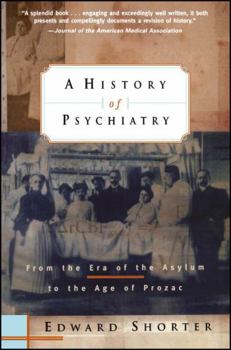
A History of Psychiatry: From the Era of the Asylum to the Age of Prozac

Select Format
Select Condition 
Book Overview
Revised
Format:Paperback
Language:English
ISBN:0471245313
ISBN13:9780471245315
Release Date:March 1998
Publisher:Wiley & Sons, Incorporated, John
Length:448 Pages
Weight:1.50 lbs.
Dimensions:1.2" x 6.2" x 9.1"
Customer Reviews
4 ratings
History of Psychiatry from the Era of the Asylum to the Age of Prozac
Published by Thriftbooks.com User , 18 years ago
Excellent, well written and researched historic account of the history of psychiatry during this period. Well worth reading for everyone interested in mental health care.
Great book:The rise, fall and rise of biological psychiatry
Published by Thriftbooks.com User , 26 years ago
This book is a well written acount of the development of psychiatry through the ages. It shows in great detail (sometimes too much, hence only 4 stars) the rise, fall and rise of biological psychiatry. Especially the part of the second rise and the decline of psychoanalysis is a must read for everyone interested in this subject. After reading this book everyone should understand that there is only one side to psychiatry and that is the biological side.
Intelligent, principled creitical review which informs, guid
Published by Thriftbooks.com User , 28 years ago
Highly intelligent, principled writing. Not opinionated, but has opinions, argues for them, convinces the reader. Informative but does not aequalize between imporatent and unimportant. Brilliant style, most amusing.
Ah, so _that's_ what happened.
Published by Thriftbooks.com User , 28 years ago
I loved this book. Terrific. Over and over it tied together and made sense of things that had puzzled me. To get personal: in the fifties, my father spent a small fortune on traditional Freudian psychoanalysis. And it did him a lot of good. For years, I believed Freudian psycyoanalysis was scientific. For one things, it just _had_ to be. No charlatan could go to the effort and expense of getting an MD, then board certification in psychiatry, then undergo psychoanalysis, just in order to con people. Yet in some way that I didn't quite understand, I became aware than nowadays Freudian psychoanalysis is considered to be a pseudoscience, on about the same level as orgone boxes or homeopathy or Christian science. How _could_ my parents have fallen for it? How _could_ the medical community? Well, Shorter explains what happened in a way that makes sense, seems clear, and (to my mind) is really quite sympathetic to the psychoanalytic community and its clients. Along the way he ties up a lot of loose ends. All through the book I kept saying to myself things like, "Oh, so _that's_ what 'neurasthenia' was" (people in novels written early in the century often had it). "Wow, so that's what the word 'degenerate' is really referring to."
Copyright © 2026 Thriftbooks.com
Terms of Use | Privacy Policy | Do Not Sell/Share My Personal Information | Cookie Policy | Cookie Preferences | Accessibility Statement
ThriftBooks ® and the ThriftBooks ® logo are registered trademarks of Thrift Books Global, LLC
ThriftBooks ® and the ThriftBooks ® logo are registered trademarks of Thrift Books Global, LLC
