


< Back to Search Results

Food of the Gods


Select Format
Select Condition 
Book Overview
What happens when science tampers with nature? A riveting, cautionary tale with disastrous results reveals the chilling answer.Hoping to create a new growth agent for food with beneficial uses to... This description may be from another edition of this product.
Format:Hardcover
Language:English
ISBN:0848812166
ISBN13:9780848812164
Release Date:April 2004
Publisher:Amereon Limited
Length:190 Pages
Related Subjects
Classics Fantasy Fiction Literature & Fiction Science Fiction Science Fiction & FantasyCustomer Reviews
5 ratings
Boom food forever.
Published by bernie4444 , 12 days ago
“Bigger isn't necessarily better.” Dr. Ruth Westheimer.
This is one of HG’s more popular books. This was made into the movie “The Food of the Gods” (1976) and is closer to the book “Night of the Lepus” (1972), which was an early form of Rabbit Transit.
As with all of HG’s work, this is more of a social commentary than it is a sci-fi story.
A scientist finds a way or food to keep growth from being inhibited. It gets out of hand in several stories, each tied together with a single theme. The first part of the story is simple: “how you deal with big chickens.” However, it gets a little more complex when it is “how do you deal” with big people. HG shows how England is a stagnant society in the least changes that upset the status quo and need to be squelched.
As you can see, he split this up into several books; each book is a stand-alone story yet counts on the story before it. As you read this story, you must think about how I react if I had to deal with giants, how I react if I were the giant. Hopefully, we come away from the story with a better understanding of how society works and /or can work.
"He was no more than a great black outline against the starry sky, a great black outline that threatened with one mighty gesture the firmament of heaven and all its multitude of stars."
Was Dr. Ruth and her assumption correct?
Boom food forever
Published by Thriftbooks.com User , 16 years ago
"Bigger isn't necessarily better." Dr Ruth Westheimer This is one of HG's more popular books. This was made into a movie "The Food of the Gods" (1976) and closer to the book "Night of the Lepus" (1972) which was an early form of Rabbit Transit. As with all of HG's work this is more of a social commentary than it is a sci-fi story. A scientist finds a way or a food to keep growth from being inhibited. It gets out of hand in several stories each tied together with the single theme. The first part of the story is simple how you deal with big chickens. However it gets a little more complex when it's "how do you deal" with big people. HG shows how England is a stagnant society in the least changes upset the status quo and need to be squelched. As you can see he is split this up into several books each book being a stand-alone story yet counts on the story before it. As you read this story you must think how I react if I had to deal with giants, how I react if I was the giant. Hopefully we come away from the story with a better understanding of how society works and /or can work. "He was no more than a great black outline against the starry sky a great black outline the threatened with one mighty gesture the firmament of heaven and all its multitude of stars." Was Dr. Ruth and her assumption? The Food of the Gods Night of the Lepus ~ Stuart Whitman
Quite good
Published by Thriftbooks.com User , 21 years ago
When the scientists Bensington and Redwood create a new compound which turns growth in all living things from a series of bursts and intermission into a constant, they have no idea how it will affect the world. Indeed, when this new "Food of the Gods" gets loose, it begins to grow giant plants and animals...and giant people. But, is the world big enough to hold an aging race of pygmies and a young race of giants? This now largely forgotten work was written by H.G. Wells (1866-1946) in 1904, during his brief sojourn with the Fabian Society. Mr. Wells did not write his science fiction to tell entertaining stories; instead, he used his stories as vehicles for social commentary. In this particular book, Wells introduces a new race of mankind, large and capable - born outsiders who can not possibly fit into the social constructs that surround them, much less understand them. Now, unlike War of the Worlds and The Invisible Man, why did this book fade into obscurity? Overall, I would say that Wells critique of Edwardian society is not deep enough to allow this story to transcend that setting. Also, while the story is quite good, it is not great, unlike those other stories. So, am I saying that you should skip this book? Definitely not! H.G. Wells was a tremendous storyteller, and this story is quite entertaining. If you are a fan of Edwardian literature, or just like a good story, then you will definitely like this book. I highly recommend it.
Prescient
Published by Thriftbooks.com User , 22 years ago
>Of course people have gotten bigger in the 20th century, due primarily to better nutrition, health care, excercise, etc., but we are hardly the 40 foot giants Wells' talks about. <p>Look up "nutrition" in a dictionary: It means "food". In particular people have gotten RADICALLY taller in the last fifteen years of the twentieth-century--a remarkably short span of time--due to what's being put INTO food (chemicals--I'm not talking about vitamins here): not "bigger", TALLER. Taller, thinner, less muscular, more stretched out, in a word, misshapen, disfigured. <p>This book can be taken as a parable or an adventure story, and so on, but to a remarkable extent it happens to be a DEAD-ON prophecy.
The science is real,and the characters come alive
Published by Thriftbooks.com User , 27 years ago
H.G.Wells wrote a special novel,with science fiction(which is getting closer and closer to fact every day),definite characters(the scientists and the townfolk are definite personalities),social commentary(can 6-foot people and 40-foot people accept one another?)and human feelings(the tragedies of Bensington and Caddles are truly touching).
The Food of the Gods and How It Came to Earth Mentions in Our Blog
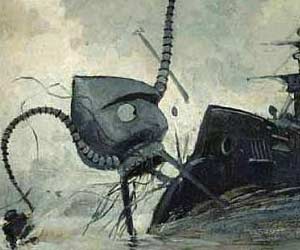
The (Surprisingly) Powerful Influence of H.G. Wells on Modern Day America
Published by Beth Clark • September 21, 2018
A hundred years ago, novelist H.G. Wells predicted that science would be "king of the world." Titanic's Jack Dawson may take issue with that claim, but he’d have a tough time disputing the compelling influence Wells had on politics, society, and the future that extended far beyond the literary realm. Considering Wells is one the founding fathers of sci-fi (along with Jules Verne and Edgar Rice Burroughs) and the author of The Time Machine, The Invisible man, The Island of Dr. Moreau, and The War of the Worlds, that's saying something.
Copyright © 2026 Thriftbooks.com
Terms of Use | Privacy Policy | Do Not Sell/Share My Personal Information | Cookie Policy | Cookie Preferences | Accessibility Statement
ThriftBooks ® and the ThriftBooks ® logo are registered trademarks of Thrift Books Global, LLC
ThriftBooks ® and the ThriftBooks ® logo are registered trademarks of Thrift Books Global, LLC
