


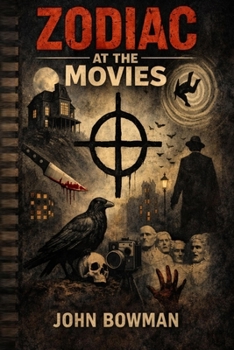
Zodiac At The Movies

The Zodiac Killer case has been examined for decades through suspects, timelines, ciphers, and forensic speculation. Zodiac At The Movies takes a fundamentally different approach. Rather than asking who the Zodiac was, this book asks how the Zodiac story worked-and why it has endured.
Drawing on film theory, narrative analysis, and media history, John Bowman argues that the Zodiac's crimes, letters, symbols, and silences functioned less as expressions of motive than as deliberate interventions into a media environment already shaped by cinema. The case unfolded not simply as a sequence of violent acts, but as a staged narrative governed by recognizable cinematic principles: establishing shots, delayed authorship, suspense, montage, escalation, fragmentation, and unresolved endings.
Beginning with Lake Herman Road as an "establishing shot stripped of guidance," the book traces how meaning was imposed retroactively through letters that claimed authorship and reorganized earlier violence into a coherent character. Subsequent chapters examine how speech followed action rather than accompanied it, how the Zodiac edited media representations to preserve abstraction, and how ciphers transformed passive spectators into active participants
As physical violence receded, threat replaced action. As threats lost urgency, communication fragmented into symbols, postcards, and visual references. The narrative shifted from escalation to repetition, from control to fatigue, and finally to disappearance-leaving behind a story without an ending. In its later chapters, the book examines how media, audiences, and cultural memory collectively sustained the Zodiac after his silence, transforming an authored performance into a self-perpetuating cultural artifact
Crucially, Zodiac At The Movies does not claim that films caused the Zodiac's crimes, nor does it attempt to identify a suspect or resolve the case. Instead, it treats cinema as behavioral context-a shared grammar that shaped how violence could be staged, understood, and remembered in a media-saturated society. The analysis is explicitly restrained: ambiguity is acknowledged rather than filled, and description is never offered as admiration or glamorization
This book is not a true-crime thriller and not a whodunit. It is a structural analysis of one of America's most enduring criminal narratives-and a study of what happens when violence, media, and audience attention intersect.
Zodiac At The Movies is for readers interested in:
Serious true crime without suspect speculation
Film theory, media studies, and narrative structure
The ethics of attention, spectacle, and audience participation
Why the Zodiac case persists even without an ending
Cinema does not explain who the Zodiac was.
It explains why the story unfolded the way it did-and why it still has not let us go.
Customer Reviews
ThriftBooks® and the ThriftBooks® logo are registered trademarks of Thrift Books Global, LLC
