


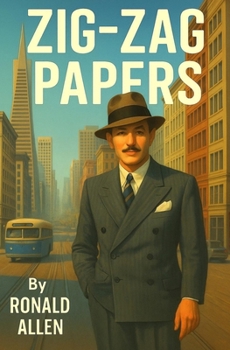
Zigzag Papers

In a city soaked with fog, incense, and the hum of distant guitars, Zig-Zag Papers unfolds like a dossier never meant to be opened - a file stamped confidential and left in the rain. These are the cigarette-stained notes of Frank "The Shadow" Dwyer, a Pinkerton detective walking the line between duty and delirium during San Francisco's descent from the Beat twilight to the exhausted morning after the Summer of Love. Routine paperwork turns to scripture for the disenchanted. Every page cuts another line through the smoke and makes the reader complicit.
The investigations begin on Haight Street, where windows glow like stained glass and the air smells of incense and revolution-on-credit. Dwyer listens to whispers through bead curtains, meets midnight gurus, and finds manifestos scrawled by kids who haven't eaten in days. But the trail doesn't stay in the light. It ends in the alleys near the waterfront, where neon skims across puddles like broken promises and every truth holds a lie. Between these worlds runs a zig-zag of suspects and ghosts - the doctor who faked his death, the widow who never cried, the man with the inadequate smile, the self-made prophet, and letters that seem to write themselves.
As the decade unfolds, Dwyer's path becomes a map of fracture - illusion versus consequence. A single letter sets betrayals in motion, pulling him into interrogation rooms where every word has two meanings. The cases stretch across the city's restless geography: red-light corridors, abandoned synagogues, forgotten side streets, and mansions where trust is thinner than cocktail ice.
He learns that even free love has a price, and revolutions keep receipts. The counterculture that promised transcendence curdles; ideals turn to currency, and songs of liberation fade into background noise for hustlers and opportunists. San Francisco begins humming with something colder - a buzz of paranoia and whispered deals behind locked doors.
By the time the files blur, Dwyer is lost in a maze of forged identities, missing girls, vanished prophets, and compassion gone wrong. Fog-bound piers swallow the desperate. Warehouses breathe like sleeping giants. Wallpaper peels like old confessions in motels where protest songs play for nobody. The people who once swore they were changing the world are just trying to survive it. Dwyer begins to ask not who's guilty - but whether innocence ever existed here at all.
As the cases spiral inward, the mirror turns. The watcher becomes the watched, the investigator the accomplice, the unreliable narrator. Reality frays; science and superstition trade places. Truth and hallucination thin to rolling paper. By the final file, he's chasing ghosts of his own making, the trail looping back to the case that was never separate from him.
In the final movement, the threads pull tight: a torn matchbook, a switched morgue tag, a confession breathed through fog. All the cases collapse into one last deception as the Summer of Love gives way to a cold dawn. When it ends, the reader stands beside Dwyer at the Bay, cigarette burning down, watching the mist lift over a city that forgets everything except how it felt.
Zig-Zag Papers is a mosaic of noir and nostalgia - neon on fog, drums in Golden Gate Park, peace and paranoia sharing the same sidewalk. It's what happens when ideals meet alleyways, when love turns to leverage, when truth comes rolled in smoke. More than a detective story, it's a meditation on memory and disillusionment, on the quiet bargains struck to survive. For readers of Hammett, Chandler, Ellroy, and the darker side of Kerouac's America, Zig-Zag Papers offers the final cigarette before sunrise - a story of betrayal, memory, and the strange light that glows just before the city forgets you.
Customer Reviews
ThriftBooks® and the ThriftBooks® logo are registered trademarks of Thrift Books Global, LLC
