


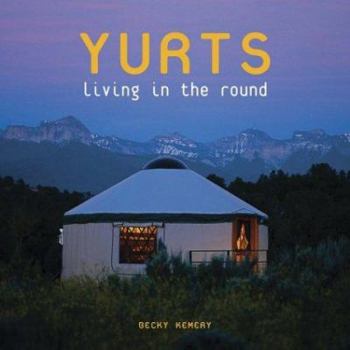
Yurts: Living in the Round

Select Format
Select Condition 
Book Overview
This work journeys from Central Asia to modern America and reveals the history, evolution, and contemporary benefits of yurt living. One of the oldest forms of indigenous shelter still in use today,... This description may be from another edition of this product.
Format:Paperback
Language:English
ISBN:1586858912
ISBN13:9781586858919
Release Date:August 1970
Publisher:Gibbs Smith, Publisher
Length:160 Pages
Weight:1.41 lbs.
Dimensions:0.5" x 8.5" x 8.6"
Age Range:18 years and up
Customer Reviews
5 ratings
Excellent and the best Yurt book
Published by Thriftbooks.com User , 18 years ago
The author has lived in various yurts in enough states to have some wisdom to share since climates can change and a yurt in the dessert is different than one high in the Sierras or Rockies where the temperatures can get well below freezing. She writes of the history of yurt dwellers and how modern fabrics here in the states make yurts weather proof in most areas and livable homes year round. As a member of the Small House Society I am looking for a variety of small house choices and yurts and boats are at the top of my dream list. Her examples also show the modern yurt like the ones here in the Sierras that all have windows, skylights, doors and most amenities one can find in a small modern home. Read other 5 star reviews who tell you even more. Excellent book.
Great Book
Published by Thriftbooks.com User , 19 years ago
"Yurts: Living in the Round" is put together very well. It is clear and concise, bright and full of photos, and covers just about everything you'd ever need to know about yurts. It is obvious upon reading the book that the author has used her own extensive personal knowledge and experience in writing it.
Beautiful and Comprehensive
Published by Thriftbooks.com User , 19 years ago
Ever since I first heard that Becky Kemery was writing a book about Yurts I have been looking forward to having it in my hands. The wait has definitely been worth it, now that I can see how fully realized her idea has become. Yurts: Living in the Round was published in 2006 by Gibbs Smith, and is the definitive source of information about anything to do with yurts. Not only that, it is also a fine piece of art in its own right; nearly every page is graced with carefully laid out color photos and drawings. Becky's writing is both clear and well researched. Becky writes, "Most yurts are portable, tent-like structures. They have circular lattice walls (reminiscent of baby gates tied together) and a cone-shaped roof supported by rafters that meet in a center ring. The outer fabric shell of the yurt can be made of felted wool, coated canvas, or a modern architectural fabric. An ever-increasing number of wooden structures are also called yurts. What defines them as yurts and not just round houses? The Answer lies in the yurt's uncommon roof structure." "The yurt roof incorporates a unique architectural design. Roof struts meet in a center ring, producing inward and downward pressure. This center ring holds the rafters an a state of compression. Where the struts meet the wall at the perimeter, a natural outward thrust occurs. A band (of rope, woven cloth, or wire cable) a the top of the wall holds the wall and roof poles in tension against this outward pressure. Because of this...long roof spans are possible without any internal support system (like posts, trusses, or beams). This gives the yurt an uncommon feeling of spaciousness and uplift. the roof design also creates an incredibly strong and resilient structure that is uniquely equipped to withstand earthquakes, strong winds, and heavy snow loads." The historical evolution of the modern yurt from its origins with the nomadic Central Asian tribes is carefully outlined. Both the Mongolian Ger and the Turkic Uy are the forerunners of what we now call the yurt. How these tribal folks traditionally make and decorate their portable homes is both fascinating and colorful. This process is generally a group effort and often involves painstakingly felting the wool to make the covering. The traditional pattern of living within this circular space is surprisingly similar to Native American traditional use of space within a hogan, with various family members and guests having their appropriate places. One of the early modern adaptations of the traditional yurt design was Bill Copperwaite's "tapered wall yurt." These are wooden structures that incorporate the same roof design, but modify the vertical walls to incline outward, giving them a distinctly oriental flare. Bill has been exploring these interesting shapes since the early 1960's, and has come up with quite a variety of forms, including some with concentric tiers of yurts within yurts. Some of them have scalloped butterfly-like roofs; others have got
The blend of color photos and lively yet practical 'how to' advice' is unique.
Published by Thriftbooks.com User , 19 years ago
YURTS: LIVING IN THE ROUND offers both a history of the nomadic yurt round house design and a survey of contemporary fabric yurts and how to build them, making it an excellent choice for any lending collection strong on alternative home-building options. Accounts from those who built and lived in yurts accompany color photos of differing styles and options, insights on how to choose and work with a yurt company, and even bear proofing a yurt. The blend of color photos and lively yet practical 'how to' advice' is unique. Diane C. Donovan California Bookwatch
Contemporary Benefits of Living in a Yurt
Published by Thriftbooks.com User , 19 years ago
"The healing, creative, communal, and spiritual nature of yurts is broadly recognized. Yurts seem especially suited to certain pursuits." ~ pg. 13 Why do people dream more when they live in a yurt? Why is the oldest form of indigenous shelter still being built today? Have you always dreamed about living in a round house because it makes you feel more peaceful? Walk into any room that has a circular design and notice how you react. "Yurts: Living in the Round" takes this research many steps further to the point of answering these questions: Which yurt would be best for your lifestyle? Where to find a yurt builder or should you do it yourself? How should you determine which floor plan to use? Case studies and personal stories of yurt dwellers are explored and pictures throughout paint a picture of a peaceful lifestyle lived in natural settings. Some of the pictures show doors of a Mongolian ger, painted in bright colors. There are treehouse yurts, wooden yurts, fabric yurts, camping yurts and communal yurts. One snow covered yurt looks like an igloo. A gorgeous picture of a yurt with light glowing from the center is shown against a luminous emerald background of northern lights. I've always been fascinated by the idea of living in a building shaped like a tower, but maybe what I truly love is just a round building with the feeling of open space and lots of windows. Many of the yurts featured in this book have been adapted into modern designs and one in particular shows how you can adapt a yurt to a variety of living spaces. Furnishings, hanging fabrics and screens create private spaces that look very romantic. I love the idea of the freedom of living in one big space because walls between the rooms often feel restrictive. If you love rooms where the kitchen flows to the living room with high ceilings, yurts may truly appeal to you. A garden yurt also sounds appealing as a writing escape or artist studio. This book takes you from the history of yurts all the way to very modern applications for the yurt design. The author lives in a yurt in Idaho, surrounded by herb and vegetable gardens. Through the years she has lived in four different yurts in three states and now offers her advice and wisdom to anyone who wants to experience this lifestyle. ~The Rebecca Review
Copyright © 2026 Thriftbooks.com
Terms of Use | Privacy Policy | Do Not Sell/Share My Personal Information | Cookie Policy | Cookie Preferences | Accessibility Statement
ThriftBooks ® and the ThriftBooks ® logo are registered trademarks of Thrift Books Global, LLC
ThriftBooks ® and the ThriftBooks ® logo are registered trademarks of Thrift Books Global, LLC
