


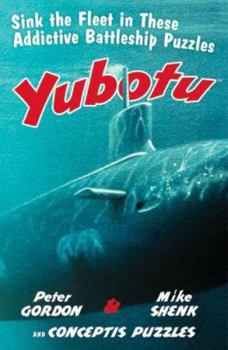
Yubotu: Sink the Fleet in These Addictive Battleship Puzzles

Here it is: the next big puzzle sensation, destined to join sudoku and kakuro as a bestselling blockbuster. Yubotu is the Japanese word for "U-Boat" or submarine, and this collection plays a variation on the traditional favorite known as Battleships. It's co-created by Peter Gordon and Mike Shenk, the team that first brought this type of puzzle to America. The object is to locate 10 ships in a fleet--four subs, three destroyers, two cruisers, and one battleship--all hidden in an "ocean" represented by the spaces in a grid. An introduction explains all the basics in detail, taking solvers through a sample puzzle, with the puzzles getting more difficult as you go along until they're absolutely brain-busting
Format:Paperback
Language:English
ISBN:1402741898
ISBN13:9781402741890
Release Date:September 2006
Publisher:Puzzlewright
Length:144 Pages
Weight:0.40 lbs.
Dimensions:8.0" x 0.5" x 5.3"
Customer Reviews
2 ratings
Boat-loads of Fun!! Easier than Paint-doku
Published by Thriftbooks.com User , 17 years ago
This book is like playing "solitaire Battleship". You need to find where the ships go, using clues given by the few spaces already filled in and the numbers along horizontal and vertical edges. I found it as easy to learn as Sudoku and Kakuro, but much easier than Paint-doku. Very nice progression in difficulty levels. The basic solving techniques work well for the first few levels, but nearer the end of the book I worked a lot of trail-and-error process of elimination. Decent paper quality, as I did need to erase some grids and found that the paper held up just fine. Tips: if you are going to fill in the whole square, use a dull pencil, not a sharp one or a mechanical pencil. Do not shade them in with a heavy hand in case you want to erase. You can use simple markings instead of shading entire squares. For example, I use dots instead of filling in whole squares. And a single wavy line for water instead of 4 lines as shown in print. These puzzles are super fun!
Fun and addicting puzzles
Published by Thriftbooks.com User , 18 years ago
It seems natural when reviewing grid-based pencil-and-paper puzzle game to compare it to Sudoku. I think Yubotu compares quite favorably. It has much the same deductive reasoning, challenge, and addictive qualities that I believe have made Sudoku popular, but with a minimum of tedium. The rules are quite simple. There are some basic parameters about where ships may be placed in relation to each other and the number and size of the ships which must be found. You are given numbers for each axis of the "ocean" grid which indicate how many squares are occupied by part of a ship. Your job is to use these rules to draw them all in. The book begins with an Introduction, which is a nice summary of the rules and outlines the advanced strategies needed later. It has 180 puzzles, two-per-page and divided into sections of increasing difficulty: Seaman, Petty Officer, Ensign, Captain, Commodore, and Admiral. At the end is an answers section with answers to all of the puzzles. I've stuck a pencil in my current place, put a rubber band around the whole thing, and taken it with me whenever I needed something to occupy my time. True to the text on the title, I find solving the puzzles to be addictive. Definitely recommended!
Copyright © 2026 Thriftbooks.com Terms of Use
| Privacy Policy | Do Not
Sell/Share My Personal Information | Cookie Policy | Cookie Preferences | Accessibility Statement
ThriftBooks® and the ThriftBooks® logo are registered trademarks of Thrift Books Global, LLC
ThriftBooks® and the ThriftBooks® logo are registered trademarks of Thrift Books Global, LLC
