


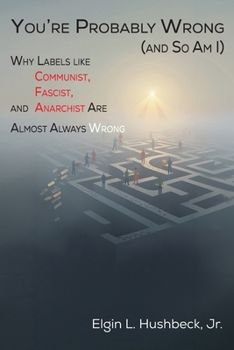
You're Probably Wrong (and So Am I)

In a polarized world where name-calling and accusations split the country into various factions, it is incredibly tempting to think that anyone who disagrees is simply uninformed or fundamentally flawed.
Elgin L. Hushbeck, Jr. argues in You're Probably Wrong (And So Am I) that the reality is far more complex. Disagreements are often not about one side being "right" and the other "wrong," but rather stem from our inherent lack of perfect knowledge and the different ways we process information.
Many political disputes are actually clashes over definitions and foundational values rather than facts. For instance, both sides can be factually correct yet still disagree because of differing definitions. Furthermore, the book explores how the fundamental political divide is often a delicate balancing act between mutually exclusive values, such as liberty and equality. Because an increase in one often requires a decrease in the other, intelligent and compassionate people will naturally reach different conclusions based on which value they prioritize.
Hushbeck clarifies the political landscape by tracing our modern labels back to the competing ideals of the French and American Revolutions. He demonstrates that the conventional political spectrum is often nonsensical, and explains why labels like "Communist," "Fascist," and "Anarchist" are almost always historically inaccurate and toxic to genuine discourse. Instead, he proposes a clearer framework that separates democratic debates over government size from the authoritarian spectrum of absolute control.
The only way to resolve these deep-seated disagreements is through honest, open discussion that seeks to clarify definitions and uncover underlying foundations. By learning to tolerate opposing views and prioritizing truth over partisan bickering, we can finally move toward a better understanding of one another and the complex world we share.
Customer Reviews
ThriftBooks ® and the ThriftBooks ® logo are registered trademarks of Thrift Books Global, LLC
