
Skip to content
Scan a barcode
Scan
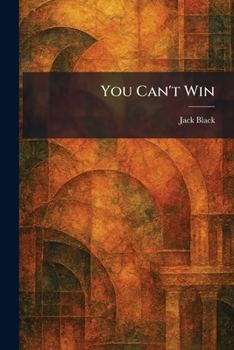
Paperback You Can't Win Book

ISBN: 1026096928

ISBN13: 9781026096925

You Can't Win

Select Format

Select Condition ThriftBooks Help Icon

Recommended

Format: Paperback

Condition: New

$25.95
Ships within 2-3 days
Save to List

Book Overview

"You Can't Win" is the gripping autobiography of Jack Black, a professional burglar, hobo, and perennial fugitive who navigated the shadows of the American underworld at the turn of the 20th century. Written with unflinching honesty and a keen eye for detail, the narrative chronicles Black's life of crime across the Western United States and Canada, offering a rare and vivid glimpse into the subcultures of freight-hopping yeggmen and the brutal realities of the early American prison system.

Through his experiences, Black explores themes of survival, honor among thieves, and the crushing weight of a legal system designed more for punishment than rehabilitation. The work serves as both a thrilling adventure tale and a sobering social document, detailing the specific techniques of safecracking and the complex social hierarchies of the road. Ultimately, "You Can't Win" is a story of transformation, documenting the author's eventual rejection of a life of crime in favor of a path toward reform and redemption. This memoir remains a classic of hobo literature and an essential read for those interested in the history of criminology and the lived experience of the American margins.

This work has been selected by scholars as being culturally important, and is part of the knowledge base of civilization as we know it. This work was reproduced from the original artifact, and remains as true to the original work as possible. Therefore, you may see the original copyright references, library stamps (as most of these works have been housed in our most important libraries around the world), and other notations in the work.

This work is in the public domain in the United States of America, and possibly other nations. Within the United States, you may freely copy and distribute this work, as no entity (individual or corporate) has a copyright on the body of the work.

As a reproduction of a historical artifact, this work may contain missing or blurred pages, poor pictures, errant marks, etc. Scholars believe, and we concur, that this work is important enough to be preserved, reproduced, and made generally available to the public. We appreciate your support of the preservation process, and thank you for being an important part of keeping this knowledge alive and relevant.

Customer Reviews

4 ratings

One of the most captivating books ever written

I first discovered Jack Black's `You Can't Win', as I suspect many readers did, when I found out that it was William S Burroughs' favourite book. Until I read it, though, I couldn't imagine just how big an influence it was on Burroughs - who drew upon its style, and the code of honour it describes, for the entirety of his writing career.When you read Burroughs' foreword to this edition of `You Can't Win', it hits you that he didn't (as you might assume with a favourite book) reread the book regularly. Rather, he memorised the book as a boy, and then throughout his life `read' the version memorised in his own mind. Even the passages that Burroughs quotes in the foreword aren't word-for-word precise (I compared them with the text of the book proper), because they've been committed to myth and memory, and are recited in ritualistic fashion.All of which aside, `You Can't Win' deserves to be known as more than just `the book that inspired Burroughs'. It's written in a plain, unsentimental style which has as much in common with the writing of Charles Bukowski as it does with the Beats - a style of writing which reached its apotheosis with `The Grass Arena', the harrowing autobiography of the British alcoholic vagrant John Healy. (Now, someone should teach a literature class comparing `You Can't Win' and `The Grass Arena' - THAT would be an inspiration.) What these writers have in common is that when you read them, you instantly think: `Now this is good, compelling, uncluttered prose.'Many of those who have posted reviews below rightly praise Jack Black's memorable language and characterisation, which make `You Can't Win' into a kind of turn-of-the-century lexicon and encyclopaedia of the life of American thieves and hobos. But I was even more struck by Black's remarkable resolve, self-dependency and moral fortitude, and above all his categorical refusal to feel sorry for himself, or to let the reader feel sorry for him.Three passages in the book in particular, all of which concern prison, are horrific - two passages in which Black is punished by flogging, and an absolutely unbearable passage in which he is tortured in a straitjacket by a sadistic prison warden. If these passages had been written by a lesser writer, I could not bear to read them. But Black takes the reader firmly by the hand, conveys what happened to him, and moves on.Describing the first flogging: `It would not be fair to the reader for me to attempt a detailed description of this flogging.... If I could go away to some lonely, desolate spot and concentrate deeply enough I might manage to put myself in the flogging master's place and make a better job of reporting the matter. But that would entail a mental strain I hesitate to accept, and I doubt if the result would justify the effort.'Describing the second flogging: `To make an unpleasant story short, I will say he beat me like a balky horse, and I took it like one - with my ears laid back and my teeth bared. All the philosophy and lo

A simple account of a life

Hard. Unforgiving. Undeniably American.First the good news: this is a harrowing story of a misspent life from the man who chose to waste it. He is brutally honest; a better writer would have excluded the coarse sentimentality here. However, that would make this a false document or impair its ability to stir your emotions. I admire this man greatly. He is a hardened criminal who loves books and easy money. He describes, in great detail, the allure of crime in a simple, direct style.The bad news: this man is not a professional writer. If you are looking for a distinctive prose style or something that will fit into a literary cubbyhole, this is not the book for you. This is not a beat book. This is not an avante-garde book. This is a book written by a man who has lived a long and puzzling life with comparatively little formal education. It is probably closest to "Papillon" or any other true life story.

More than just a Burroughs influence

This is a bright engaging book that deserves wider audience than its current incarnation as an influence on Burroughs is giving it. The hobo-thief underworld of an American past is truly alive in these pages, and it made me wistful and meloncholy for times and places I'll never know. I want to stop at the hobo junctions of Montana and Idaho from this true-life tale, but I'm afraid of what I'd find there today.

Jack Black is a fascinating and utterly unforgettable book.

From train tracks to opium dens, and finally to the stability of a job at the San Francisco Public Library, Jack Black writes a very personal account of adventure, hardship, loneliness, and longing. I absolutely loved this book. Black is a wonderfully interesting person, and his story is like none that I have ever found anywhere else--the story of a hobo in the early 1900's, who steals, does drugs, lives like a bum, rides the trains, and eventually decides he's had enough, settling down to a more conventional lifestyle.He is the kind of person you want to meet and have a beer with. When the book was over I lent it to every person I cared about and they all loved it too.
Copyright © 2026 Thriftbooks.com Terms of Use | Privacy Policy | Do Not Sell/Share My Personal Information | Cookie Policy | Cookie Preferences | Accessibility Statement
ThriftBooks ® and the ThriftBooks ® logo are registered trademarks of Thrift Books Global, LLC

GoDaddy Verified and Secured