


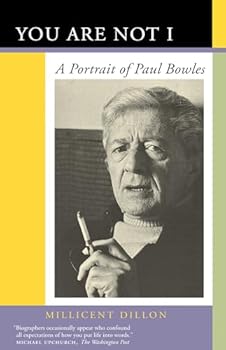
You Are Not I: A Portrait of Paul Bowles


Select Format
Select Condition 
Book Overview
The famously enigmatic writer-composer Paul Bowles is the subject of Millicent Dillon's unforgettable new book. Her portrait of the chameleonlike artist is much more than an account of Bowles's life,... This description may be from another edition of this product.
Format:Paperback
Language:English
ISBN:0520224930
ISBN13:9780520224933
Release Date:January 1998
Publisher:University of California Press
Length:368 Pages
Weight:2.05 lbs.
Dimensions:8.7" x 0.9" x 5.4"
Customer Reviews
3 ratings
A very revealing portrait of a very reclusive writer
Published by Thriftbooks.com User , 22 years ago
Paul Bowles, probably best known for The Sheltering Sky, which arrived on the literary scene in 1949 signaling the impending arrival of that Pandora's Box better known as Postmodernism, was a living literary anachronism. He was the American expatriate artist non plus ultra, the bohemian incarnate, someone who had turned his back on America in a quiet gesture of rebellion to follow his true calling as a writer and composer, travelling the world and finally coming to rest in distant, exotic Tangier. The fact that he'd quit college and run away to Paris to rub shoulders with the literati and surrealists, and had managed to be received by Gertrude Stein, confirmed for many the non-academic view of how one could move up in the world. And the fact that it was Gertrude Stein who suggested to Bowles that he stop writing poetry, and that he should visit Tangier, sanctioned the belief in the life-altering powers of chance and synchronicity, endearing him to the Beats, the hippies, and generations to come.Above all, it was Bowles' unique stance as an outsider in the otherwise clubby world of literature that appealed to many. Although frequently associated with the Beats, other than a few snapshots where he appears in the company of Allen Ginsberg, William Burroughs and Gregory Corso, and despite the fact that Bowles was also an experimenter with drugs and their relation to creativity, he really didn't have much in common with the Beats. Bowles was too much the dandy and gentleman, travelling through North Africa in his Jaguar sedan with his Moroccan driver, complete with stacks of trunks and suitcases full of impeccable suits and ties and shoes, sometimes even accompanied by a parrot in a cage, about as far from On The Road as one could get while still being on the road. Bowles was Bowles wherever he went, which seemed to follow a course along the frontier of Western civilization, especially those places where it came into dangerously close contact with primitive or native cultures that had little respect or even understanding of Western ways, a sort of moveable confrontation which formed the basis of the majority of his literary work. His macabre and at time nihilistic stories and novels had more in common with post-war existentialism than anything Beat or beatific.Despite numerous interviews and articles, as well as several full-scale biographies, the opaque and enigmatic nature of Paul Bowles was already legendary in his own lifetime. Even his autobiography, Without Stopping (dubbed Without Telling by William Burroughs), told the reader basically nothing. Millicent Dillon, an excellent writer in her own right, and editor of Out in the World: Selected Letters of Jane Bowles, 1935-1970, as well as The Portable Paul and Jane Bowles, already proved her acumen and talent for biographical writing with her highly acclaimed book, A Little Original Sin, The Life and Works of Jane Bowles. In You Are Not I, A portrait of Paul Bowles, Dillon pushes the envelope of b
Yes! Read this book.
Published by Thriftbooks.com User , 27 years ago
Yes, read this book. I liked it because I felt I was in this exotic, strangely present yet distant place, with Paul & Millicent Dillon. And also Jane. Maybe you know what I mean if you like Paul Bowles.This is a loving book. It is a pleasant place to be -- with elements of disturbance, as you would expect. It is an addition to what you already have.
An Engaging Mix of Memoir and Biography
Published by Thriftbooks.com User , 27 years ago
Millicent Dillon, who wrote a wonderful critical biography of Jane Bowles, has presented readers with an equally engaging examination of Jane Bowles' husband Paul Bowles. As an inveterate reader of literary biographies and autobiographies, I enjoyed this hybrid of critical evalluation and memoir for Dillon not only reports on the sources of Bowles' fiction and his interactions with his wife she also provides a glimpse into the process of writing a biography. I appreciated her desire to get it right, to be sure she was reporting Bowles' response rather than her expository evaluation of his response. For the well-seasoned reader of Mr. and Mrs. Bowles, this book will add yet another angle to the lens. To the uninitiated, it will whet the appetite for more. To the latter, I recommend the aforementioned bio of Jane Bowles, "A Little Original Sin."
Copyright © 2026 Thriftbooks.com Terms of Use
| Privacy Policy | Do Not
Sell/Share My Personal Information | Cookie Policy | Cookie Preferences | Accessibility Statement
ThriftBooks® and the ThriftBooks® logo are registered trademarks of Thrift Books Global, LLC
ThriftBooks® and the ThriftBooks® logo are registered trademarks of Thrift Books Global, LLC
