


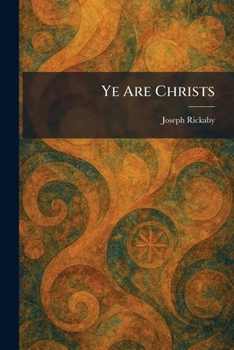
Ye Are Christs

Select Format
Select Condition 
Book Overview
"Ye Are Christs" is a profound collection of spiritual considerations and meditations crafted by the esteemed Jesuit scholar Joseph Rickaby. Drawing its title and central theme from the Pauline assertion of belonging to the Savior, this work offers a series of reflections designed to deepen the reader's personal relationship with the Divine. Rickaby explores the nuances of a devout life, focusing on the virtues and responsibilities that define the Christian character in a modern world.
The text is characterized by its intellectual clarity and deep piety, hallmark traits of Jesuit spirituality. Rickaby addresses a wide range of topics, including moral integrity, the imitation of Christ, and the necessity of maintaining a prayerful disposition amidst the distractions of daily life. By emphasizing the integration of faith and action, the work provides practical guidance for those seeking to live out their religious convictions with authenticity and grace.
A significant contribution to 20th-century Catholic devotional literature, "Ye Are Christs" remains an enduring resource for spiritual growth and theological reflection. Its timeless insights into the nature of faith and the pursuit of holiness continue to resonate with readers looking for a structured and thoughtful approach to their spiritual journey.
This work has been selected by scholars as being culturally important, and is part of the knowledge base of civilization as we know it. This work was reproduced from the original artifact, and remains as true to the original work as possible. Therefore, you may see the original copyright references, library stamps (as most of these works have been housed in our most important libraries around the world), and other notations in the work.
This work is in the public domain in the United States of America, and possibly other nations. Within the United States, you may freely copy and distribute this work, as no entity (individual or corporate) has a copyright on the body of the work.
As a reproduction of a historical artifact, this work may contain missing or blurred pages, poor pictures, errant marks, etc. Scholars believe, and we concur, that this work is important enough to be preserved, reproduced, and made generally available to the public. We appreciate your support of the preservation process, and thank you for being an important part of keeping this knowledge alive and relevant.
Customer Reviews
ThriftBooks ® and the ThriftBooks ® logo are registered trademarks of Thrift Books Global, LLC
