


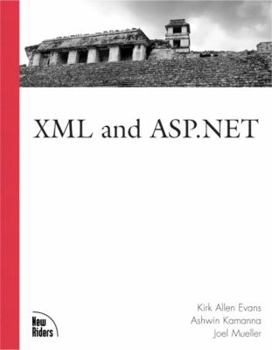
XML and ASP.NET

XML and ASP.Net explains how to create distributed software with XML, ASP.Net, XSL, CSS, XML Schemas, ADO.Net and SOAP. The authors demonstrate that Web Services is the key component of the .Net... This description may be from another edition of this product.
Format:Paperback
Language:English
ISBN:073571200X
ISBN13:9780735712003
Release Date:April 2002
Publisher:New Riders Pub
Length:822 Pages
Weight:2.75 lbs.
Dimensions:8.8" x 1.8" x 6.8"
Customer Reviews
5 ratings
Well organized and readable book on XML and APS.NET
Published by Thriftbooks.com User , 23 years ago
The book XML and ASP.NET provides a wide coverage of this subject. This book's audience is for developers already using XML, as it covers advanced NET and ASP topics. It introduces XML technologies used in the .NET framework. Readers should download the project before reading each chapter. These project files and examples are written in both C# and Visual Basic. The book covers XML on the client followed by the Server. On the server, it covers XML and ADO, XML and SQL 2000 Server, serialization and mobile applications for XML. This book provides a clearer understanding of the concepts of XML within a .NET development environment and moves the developer to the next level.
Programming with XML and ASP.NET? You need this book!
Published by Thriftbooks.com User , 23 years ago
Wow, what can I say about this book? Not enough good things anyway for starters.The three authors' desire to explain their chosen topics is evident throughout and their enthusiasm for the subject matter is infectious.Content like the .NET Framework's System.Xml namespace, the MSXML parser, database communications with XML through ADO.NET, client-side and server-side presentation of XML data are all handled expertly and explained with an air of authority that is irrefutable.Of particular interest to me (as I use it on a daily basis) was the treatment of SQL Server's handling of XML - this is, if you've ever had to trudge through SQL Server Books Online - a pretty hard topic to locate information about.I liked the appendices also - I've seen some companies shamelessly flog books with far less real content than what's contained in these ones. I particularly liked the XSLT reference as I feel that it's something that a lot of XML books that I've read have neglected.This is one the most comprehensive books that I've ever read on its topic and a great addition to any technical library.
Well Formed, Valid and Human-Readable.
Published by Thriftbooks.com User , 23 years ago
Coming up with a failsafe structure for a book on XML and ASP.NET must be a difficult undertaking given the number of essential questions that need to be asked: What level should the book be pitched at? How much background material should be covered and at what depth? Once you have devised a satisfactory tack to address these questions, then how should the XML material on ASP.NET be covered? Should we look at implementation or theory. And of course, what languages do we use to demonstrate implementation C# or VB.NET?XML and ASP.NET by Kirk Allen Evans (et al) attempts to address these questions by deviding itself into3 sections. The first section is dedicated to XML on the client but is really 5 chapters worth of XML background from the ground up. Section two is about XML on the server and the third section serves as a Reference of two well annotated appendices.The first 6 chapters deal with XML basics and a gloss of ASP.NET's involvement with this technology. These chapters are well-written on what can be regarded as background information. The chapters assume no XML knowledge, and wind through core concepts such as Push and Pull models, how XML and XSL work with each other, and a grounding on the intricacies of the MSXML and SAX parsers. An outstanding chapter here is one on XML Schemas, 'XML Schemas in .NET'. It can safely be said that this is one of best treatments of the subject that can be found in any book on the market. However it must be noted that the reader who comes to these chapters as an XML newbie will struggle. You must get a good grounding in the fundamentals of XML which are covered in other books.It is in Section 2 that we get to the content as described by the title and where the book comes into its own. The writers have clearly taken pains to elaborate not only how to implement XML using ASP.NET, but also how XML is used in the ASP.NET layer of the .NET framework. So, for example, the chapter 'ASP.NET Extensibilty with XML' looks at the metabase and provides an invaluable lesson on the uses of web.config, and how to manipulate it using the System.Configuration classes. Another good chapter is the one on ADO.NET. The first 20 pages of this chapter (at 200+ pages, probably the meatiest in the book) deals with a very high-level view of ADO.NET. The remainder deals with XML and its useage with the DataSet class. Throughout the remainder of the book, individual technologies are covered while giving glimpses on how to implement the technologies. Of all the advanced chapters, by far the most useful was the one on Serialization. The information contained on the use of XSD Schemas for strongly typed XML Serialization is worth its weight in gold. If there is one chapter that tips the scale on the decision whether to buy a book or not, it would be this one. All in all this is a distinctly worthy book. Not to be taken lightly yet covers the heaviest material with a friendly and can-do approach. It also dovetails nicely as a complement to
Finally, a book on XML that shows its real world use.
Published by Thriftbooks.com User , 23 years ago
I would recommend this book to someone who has been working with ASP.NET and needs to increase their knowledge of how XML fits into the whole scheme of things in relation to .NET. I have read some other books on XML but was never able to truly understand where and why it is used. This book gives concrete examples of XML in use, and where possible, showing how ASP.NET developers can incorporate XML into their own projects to make them more distributed, among other reasons described. What more can an ASP.NET developer ask for, the book covers all the tools available to utilize XML in ones solutions. For example, XML with SQL2000, XML with the .NET Class Libraries, XML with Visual Studio, to name a few.This book is not about the theory of XML like most other XML books are. It is about the tools available that are used to make XML do the things that it is designed to do; create productive, real world software components and solutions. There are even two actual real world sample applications included with the book. The book is not an easy read where you'll get everything the first time through. I've had to read some sections a couple times through to grasp, but my knowledge of XML was a black hole. The book is compact and focused. If you work with ASP.NET, or SQL2000, this book will make XML your strong point rather than your weak point. They even have a website dedicated to the book.
Excellent comprehensive look at new technology
Published by Thriftbooks.com User , 23 years ago
This is the best book I've seen for putting XML technology in the context of Microsoft's .NET framework. There's the standard coverage of XML concepts from the ground up, which are easy to pick up pretty quickly. This book's great strength, though, is that it places those XML concepts in the context of practical application in .NET.The book covers things such as accessing .NET XML config files, (very helpful), XML and ADO, XML and SQL Server 2K, serialization and mobile applications for XML. I'm not primarly an ASP programmer, but the config sections were immediately useful to me, and XML's new role in Microsoft's ADO/SQL technologies meant those chapters were a big help, also. The book has no CD, but it has lots of code examples. It looks like the samples are evenly divided between C# and Visual Basic.XML is a fairly easy-to-understand technology that lots of people have avoided bothering to pick up because they've had no compelling reason. Microsoft gives them a reason by embedding XML in practically every aspect of .NET. This book's a big help in getting up to speed because it's clearly written, very detailed and quite comprehensive.
Copyright © 2026 Thriftbooks.com Terms of Use
| Privacy Policy | Do Not
Sell/Share My Personal Information | Cookie Policy | Cookie Preferences | Accessibility Statement
ThriftBooks® and the ThriftBooks® logo are registered trademarks of Thrift Books Global, LLC
ThriftBooks® and the ThriftBooks® logo are registered trademarks of Thrift Books Global, LLC
