


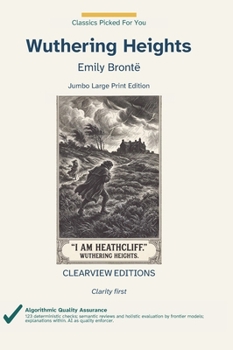
Wuthering Heights [Large Print]

The novel begins with an outsider. Lockwood, a new tenant at Thrushcross Grange, visits his landlord at Wuthering Heights and finds a household whose relationships he cannot understand. Nelly Dean's account takes him back through the events that produced it. Bront gives the reader a story told through observers, memories, letters, reported speech, and scenes of uncertain interpretation. Nelly and Lockwood are participants as well as narrators. The distance between what they see, what they believe, and what other characters disclose is central to the experience of reading the book.
Catherine and Heathcliff's attachment is only one part of this wider history. Hindley Earnshaw's resentment, Edgar Linton's loyalty, Isabella Linton's expectations, and Heathcliff's pursuit of control all shape what becomes possible for the people around them. In the next generation, young Catherine, Hareton Earnshaw, and Linton Heathcliff inherit the consequences. Their experiences repeat some earlier patterns while also revealing the possibility of learning, sympathy, and a less destructive form of companionship. Education, exclusion, illness, inheritance, and domestic power matter as much as the novel's celebrated passion.
The two houses give these relationships a physical setting. Wuthering Heights is exposed to wind and weather; Thrushcross Grange offers a different kind of comfort and social standing. Doors, windows, paths, gardens, rooms, and the open moor repeatedly determine who can enter, escape, observe, or remain apart. Bront 's landscape is therefore more than scenery. It helps organize the action and the characters' experience of freedom and confinement. Ghostly suggestions and dreams coexist with closely observed household work, money, legal arrangements, and the practical limits placed on dependent people.
This Clearview Editions volume presents the complete novel in thirty-four chapters, following the retained text of Project Gutenberg Ebook No. 768. The source comparison preserves the narrative's wording and sequence, including its closing scene at the three graves. Publisher notes identify the source and describe the preparation of this edition. They are separate from Bront 's historical text. The work was first published in 1847; this volume does not present itself as a newly annotated critical edition or add commentary to the narrative.
The 7 by 10 inch casebound edition is set in 18-point Atkinson Hyperlegible Next with 27-point line spacing. Ragged-right paragraphs and line endings without automatic word division give the text a spacious, consistent setting. Contents and chapter navigation support returning to a passage or following the story in stages. The format serves readers who want the complete novel in large type while retaining the intricacy of its voices, its shifts between generations, and the sharpness of its dialogue.
Customer Reviews
ThriftBooks ® and the ThriftBooks ® logo are registered trademarks of Thrift Books Global, LLC
