


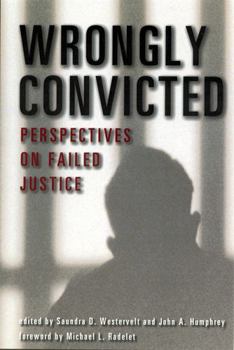
Wrongly Convicted: Perspectives on Failed Justice

The American criminal justice system contains numerous safeguards to prevent the conviction of innocent persons. The Bill of Rights provides nineteen separate rights for the alleged criminal offender, including the right to effective legal representation and the right to be judged without regard to race or creed. Despite these safeguards, wrongful convictions persist, and the issue has reverberated in the national debate over capital punishment.
The essays in this volume are written from a cross-disciplinary perspective by some of the most eminent lawyers, criminologists, and social scientists in the field today. The articles are divided into four sections: the causes of wrongful convictions, the social characteristics of the wrongly convicted, case studies and personal histories, and suggestions for changes in the criminal justice system to prevent wrongful convictions. Contributors examine a broad range of issues, including the fallibility of eyewitness testimony, particularly in cross-racial identifications; the disadvantages faced by racial and ethnic minorities in the criminal justice system; and the impact of new technologies, especially DNA evidence, in freeing the innocent and bringing the guilty to justice. The book also asks such questions as: What legal characteristics do wrongful convictions share? What are the mechanisms that defendants and their attorneys use to overturn wrongful convictions? The book also provides case studies that offer specific examples of what can and does go wrong in the criminal justice system.Format:Paperback
Language:English
ISBN:0813529522
ISBN13:9780813529523
Release Date:June 2001
Publisher:Rutgers University Press
Length:301 Pages
Weight:1.15 lbs.
Dimensions:0.8" x 6.0" x 9.0"
Age Range:18 years and up
Grade Range:Postsecondary and higher
Customer Reviews
5 ratings
1 in every 4 prosecuted defendants are actually INNOCENT
Published by Thriftbooks.com User , 16 years ago
1 in every 4 prosecuted defendants are actually INNOCENT. Many times, the "Justice System" in United States creates such errors and sends to death penalty completely innocent people. Who were just the wrong persons in the wrong place, but completely innocent. Police many times through pressure obtains FALSE confessions. And the rollercoaster goes on, sending innocent people to death, while the true criminals are free.
A must-read for anyone interested in the American justice system or death penalty
Published by Thriftbooks.com User , 17 years ago
This book is an excellent resource for anyone interested in the American criminal justice system and the death penalty. Rather than a morally based diatribe against the death penalty, it is a skillfully written critique of the death penalty as a public policy and how the institutions of justice are structured in such a way that mistakes can be made, have been made, but are extremely difficult to correct. In death penalty cases, the mistake can be permanent. Even if you are a die-hard supporter of the death penalty, it is your responsibility and duty as a member of society to at least be aware of sources of misapplication of justice and sources of error to make sure the fundamentals of justice are applied accurately and fairly. This book will help you do that. I used it for undergraduate classes and most students spoke very highly of it and talked about how it opened their eyes to issues they never thought about or were aware of. Well worth reading.
Wrongly Convicted: Perspectives on Failed Justice by Saundra D. Westervelt
Published by Thriftbooks.com User , 17 years ago
Bought for a class in college. Book arrived in a timely manner. Better than expected condition. Would buy from this seller again.
Shocking, Shocking
Published by Thriftbooks.com User , 20 years ago
Due to destructive motives such as the desire of a prosecutor to win a case at any cost, desire of the public for revenge and desire of the police to close a case with any likely candidate, many innocent persons are convicted of crimes in which they have no connection whatsoever. It is worse to convict an innocent person than it is to let a guilty person go free. However, our system, and many people serving on juries act as if it is worse to let a guilty person go free than it is to convict an innocent person. It is impossible to understand why juries convict persons who might possibly be innocent. If the juror could stand in the shoes of an innocent person being wrongly convicted, how could that juror ever let this happen.
Superb book, a must-read tour de force
Published by Thriftbooks.com User , 24 years ago
This is a simply-superb collection of essays/articles on the topic of what can lead to the criminal conviction, and even execution, of suspects who turn out to be, in fact, innocent of the crime they were arrested for.The points made and facts shown in this book should be part of a mandatory curriculum in high school, especially in view of the media onslaught of incorrect ideas of the criminal process. Most TV dramas reinforce the false "Perry Mason" idea that a successful defense attorney must not only show the prosecution has not proven its case beyond a reasonable doubt, but ALSO must come up with the truly guilty person, who will confess on the witness stand. Broadcast and print journalists insist on saying the defendant pled or was found "innocent," when the correct term is "not guilty." (There's a world of difference between "innocent" which means morally blameless, and "not guilty" which means putting the state to its burden of proof.) The "tough cop" who ignores the inconveniences of the Constitution is as much a hero in fiction, as the "slimy defense attorney" who defends the always-guilty defendant is a villain. All these might be entertaining, but they create a mindset among jurors who decide real-life guilt._Wrongly Convicted_ addresses the hard real-life questions of how things can go so wrong that an innocent person (one who had nothing to do with the crime) can wind up convicted and even executed.Would an innocent suspect sign a confession? Yes; he's coerced into believing it's actually in his interest.What characteristics of a crime most frequently create a rush to judgment with the conviction of an innocent person? A heinous crime, a marginalized or "outsider" suspect, and/or unreliable evidence.How do prosecutors avoid their requirement of disclosing facts helpful to the defense (exculpatory evidence)?Are informants reliable? Why not?Can fingerprint and DNA evidence be faked? Has it?What is the role of race?What role does the disparity of resources available to the government and defense play in conviction of the innocent?What changes can we make to prevent these convictions of the innocent?Each essay is well-written. In books like this, the editor must steer a course between overly-scholarly and overly-popular writing. The editors have chosen a middle course. The writing is not so popular that it reads like People Magazine, yet the editors use text with multiple subheadings and just the right amount of quoted material, so that it's very readable. Each essay is followed by its notes and extensive references. There is an extensive Index covering the entire book. The book concludes at a very non-ponderous 280 pages of text.My only wish is that, in addition to the current book, the editors and authors could produce a high school version, perhaps 40-50 pages of the main points and pertinent examples, suitable to inclusion in a social studies curriculum.
Copyright © 2026 Thriftbooks.com
Terms of Use | Privacy Policy | Do Not Sell/Share My Personal Information | Cookie Policy | Cookie Preferences | Accessibility Statement
ThriftBooks ® and the ThriftBooks ® logo are registered trademarks of Thrift Books Global, LLC
ThriftBooks ® and the ThriftBooks ® logo are registered trademarks of Thrift Books Global, LLC
