


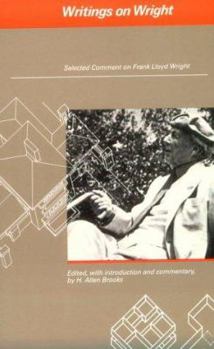
Writings on Wright: Selected Comment on Frank Lloyd Wright


These writings cover Wright's personality and life style (a New Yorker profile by Alexander Woolcott, John Noble Richards on Wright's funeral...), Wright's clients and his work (accounts by Paul and Jean Hanna, Loren Pope, Edgar Kaufmann, Jr., Russell Sturgis...), the discovery of Wright by Europeans, and more recent evaluations by Lewis Mumford and Reyner Banham, among others.
Format:Paperback
Language:English
ISBN:0262520869
ISBN13:9780262520867
Release Date:October 1983
Publisher:Mit Pr
Length:229 Pages
Weight:1.05 lbs.
Dimensions:9.3" x 0.8" x 6.3"
Customer Reviews
1 rating
finely edited scrapbook with diagrams and photos
Published by Thriftbooks.com User , 24 years ago
Much like Wright supposedly worked from the core, this book is a nice method of getting to the heart of the matter. The matter in this case is Frank Lloyd Wright because his personality, like his houses and structures, still stands out and has some gathered meaning that's not apparent which is worth seeking for the man was a leader and inspiring teacher as well as an intimidator who 'ticked' people off.Of course, his finished products nullify any notion that sweat was involved because they evoke harmony. For that sake, it's not a surprise that many books are out there now, including this one, that can assemble pieces of history to derive life-validating conclusions after he's deceased, as we continue to be amazed at Wright architecture.Wright's chosen projects began with love of the land, then complimentary design. Many of Wright's earlier works were never realized due in part because he designed as a hire and then clients did not want to pay what he was charging.Wright's life too, apart from his projects, was architectonic. He was at a peak always and never eased up toward achieving his designs until the day he died. Wright's architectural wonders we know today were projects completed when he was a septuagenarian. His first sixty or so years were spent getting educated, getting married and divorced, losing work, gaining work, and finally building up the means to teach and form his school of designers and team of construction workers.Wright was an engineer of sorts before he designed houses. His renown for environmental harmony and organic localized designs was not a result of unbridled passion or random artistry. Wright was a planner, calculator and stubborn perfectionist.The editor has attempted to dispel myths and revisit customary sayings about Wright by publishing this compilation. These writings are not in chronological order but in order of the editor's chosen themes. Some entries are not fine writing but they convey a first-hand knowledge of the man.Approximately thirty writers describe Wright through acquaintence or through scholarly studies while he was living. About a third of the book is personal correspondence. All writers knew him in one way or the other. The editor points out in the introduction that the first English-language book about Wright came out when Wright was seventy-two years old.I don't recommend this book as a primer on the life of Wright or as an introduction to his architecture. This book should follow traditional-style biographies, if any, and you should certainly look at pictures and be familiar with the U.S. locations of his famous works.
Copyright © 2025 Thriftbooks.com
Terms of Use | Privacy Policy | Do Not Sell/Share My Personal Information | Cookie Policy | Cookie Preferences | Accessibility Statement
ThriftBooks ® and the ThriftBooks ® logo are registered trademarks of Thrift Books Global, LLC
ThriftBooks ® and the ThriftBooks ® logo are registered trademarks of Thrift Books Global, LLC
