


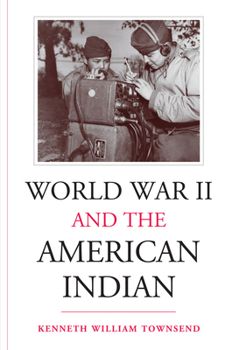
World War II and the American Indian

Select Format
Select Condition 
Book Overview
Revised
Format:Paperback
Language:English
ISBN:0826320392
ISBN13:9780826320391
Release Date:August 2002
Publisher:University of New Mexico Press
Length:284 Pages
Weight:0.97 lbs.
Dimensions:0.9" x 6.1" x 9.2"
Customer Reviews
3 ratings
Great Book
Published by Thriftbooks.com User , 18 years ago
I loved this book and it was great to learn about Native Americans. This book was apart of a class but after reading this I went and purchased the book about World War I.
Fascinating, Darkened Corners of History Illuminated Here
Published by Thriftbooks.com User , 21 years ago
This is a true story of intrigue, betrayal, social engineering gone awry, and oppression in America. Townsend's WWII AND THE AMERICAN INDIAN is primarily aimed at academics-- Native American studies professors in particular-- but this book is a revelation to those not already familiar with the many bizarre goings-on of the American government and its Right-wing critics in the tense years before, during, and after the war. Native American draft resistance, for example, was widespread-- contrary to the image of patriotic Indian, eager to defend "his" country. But most interestingly, the hidden question being explored in this work is: "Is the enemy of my enemy my friend?" History has forgotten Joseph Bruner, Alice Lee Jemison, and "Chief Red Cloud," Native Americans who were quite willing to ally themselves with outright Nazis (both in America and in Germany) in order to advance their own political agendas. They had an understandable grudge against the BIA, and decided to make a deal with the devil. Fascist crazies like William Dudley Pelley reciprocated, all too happy to advocate Native American Liberation. Pelley even argued that Native Americans should be "set free" from their reservations-- to be replaced by American Jews. Roosevelt appointees in the federal government such as John Collier, BIA head, were briefly terrified by such plans, and actively combatted them with propaganda and prosecutorial muscle. They were troubled, in the 30s, by the prospect of a multicultural fascist front-- Gold Shirts from Mexico, Native Americans, German-American Bund members. and pro-Japanese Afro Americans, etcetera-- seizing power. Reading Townsend's book, it becomes clear that their fears were largely justified. What would have happened if the American fascists had succeeded? How would history have changed? Such tantalizing questions fill this book. Townsend tells us that the Germans knew all about Navajo code talkers before the war, and had sent an agent to the Southwest under the guise of an anthropological researcher, to help crack the code. Such German outreach to oppressed peoples in America was a lead-up to WWII. Also, John Collier, controversial BIA head, was one of the main architects behind Japanese American internment during WWII. His policies towards Native Americans were the template for the "friendly" Japanese concentration camps, many of which were erected on reservations. Collier, as a liberal, was the sworn enemy of the aforementioned Pelley-- and yet, ironically, both of them advocated concentration camps, albeit with different occupants. Such fascinating, dark ironies abound in Townsend's study. All along the American Indians are treated as pawns or noble primitives or mere symbols by the powers that be, the whites, even though the reader begins to suspect that those powers needed the Indians more than the Indians needed them... One helluva great read.
Review from American Library Association's CHOICE magazine
Published by Thriftbooks.com User , 25 years ago
"Utilizing a vast array of the government's own sources, this book captures the irony of a patriotic minority again being neglected by a myopic nation."--M. L. Tate, University of Nebraska at Lincoln. For all adult readers."--CHOICE, January 2001
Copyright © 2026 Thriftbooks.com
Terms of Use | Privacy Policy | Do Not Sell/Share My Personal Information | Cookie Policy | Cookie Preferences | Accessibility Statement
ThriftBooks ® and the ThriftBooks ® logo are registered trademarks of Thrift Books Global, LLC
ThriftBooks ® and the ThriftBooks ® logo are registered trademarks of Thrift Books Global, LLC
