


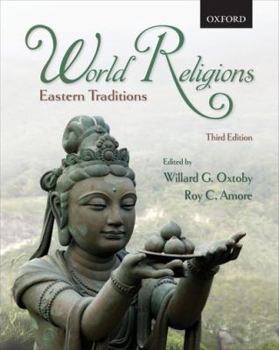
World Religions: Eastern Traditions, 3rd Edition


Select Format
Select Condition 
Book Overview
Building upon its already strong foundation, the third edition of World Religions: Eastern Traditions provides students with a thorough and in-depth survey of Hinduism, Sikhism, Buddhism, Jainism, and Chinese, Korean, and Japanese religions. Featuring work from renowned contributors, this rich and descriptive text discusses the historical basis for the religious traditions, shows how they have developed over time, and explains how they are now situated in the contemporary world. Ideal for courses in Asian religions and comparative religions, World Religions: Eastern Traditions, Third Edition, combines a historically descriptive perspective with a spirit of sympathetic fascination.
Format:Paperback
Language:English
ISBN:0195426762
ISBN13:9780195426762
Release Date:February 2010
Publisher:Oxford University Press
Length:405 Pages
Weight:1.75 lbs.
Dimensions:7.9" x 0.8" x 9.9"
Customer Reviews
2 ratings
Satisfied
Published by Thriftbooks.com User , 17 years ago
Well this book has truely been beneficial to me since I ordered it. I didn't really want to create an account with this website but after purchasing this book, I'm thinking that I'll probably order more items. I just want to thank the seller for her honesty. Everything was just as she said it would be. Now doing my paper won't be so tedious since I have the book handy.
A good survey of Eastern religions
Published by Thriftbooks.com User , 21 years ago
There is no such thing as a completely unbiased and objective text on religious studies. As other commentators on this volume have noted, there are some definite biases in this volume, but one must also allow for biases on the part of the readers, too. This book, edited by Willard Oxtoby of the University of Toronto, is the kind of book often used for introduction to world religions courses. This is part of a two-volume set; this volume deals with the major religions to come out Asian continent, as well as a few lesser-prominent traditions, such as Pacific Island religious varieties. In his introduction, Oxtoby addresses the issue of objectivity and the insider/outsider consideration about religious studies writing. The other authors, Vasudha Narayanan, Julia Ching and Roy Amore, write of Hindu and Buddhist traditions respectively, and while Oxtoby is a Christian, he writes on the subjects of the Sikh, Asian/Pacific, and general topics in the text. Narayanan also writes on the Jainist tradition, while Ching writes on less prominent East Asian religions, closer in affiliation with their own traditions than a Western academic like Oxtoby. We are not given the specifics of denomination or sectarian affiliation here, but given the purpose of writing broadly-useful texts, such classifications might hinder rather than help progress. There are major chapters on Hindu, Sikh, Jain, Buddhist, East Asian, and Asian/Pacific religions, in addition to a general chapter looking at the nature of religion in philosophical and social science terms. Each chapter incorporates history, particularly the beginnings of the religions, and the fundamental belief structures. For each major faith, a description of the current state of affairs is also included. There are photographs throughout, but not so many for a 500+ page book. There are maps, diagrams and charts relating to the subjects. Perhaps the most useful are the highlighted text boxes, which often draw into greater relief key scriptures, historical events, personalities or ideas -- given the difference in languages, most chapters conclude with a glossary of key terms. Pull-boxes can include information such as scriptural citations (Bhagavad Gita, Dhammapada, etc.), prayers and liturgical pieces, or snapshot descriptions of key issues. The concluding chapter on the nature of religion develops ideas from the philosophy of religion, the sociology and pscyhology of religion, as well as a general overview synthesis of key areas of similarity. Given that the bulk of the two volumes discusses the particularities of the religions of the world, a few pages on the similarities and shared elements is welcome. Oxtoby writes that, 'if there is one common denominator among the religions, it is humankind. Human action, human thought, and human devotion.' Well said. Each major section begins with a timeline of key dates in the development of that tradition. Each section concludes with lists for further reading, r
Copyright © 2026 Thriftbooks.com Terms of Use
| Privacy Policy | Do Not
Sell/Share My Personal Information | Cookie Policy | Cookie Preferences | Accessibility Statement
ThriftBooks® and the ThriftBooks® logo are registered trademarks of Thrift Books Global, LLC
ThriftBooks® and the ThriftBooks® logo are registered trademarks of Thrift Books Global, LLC
