


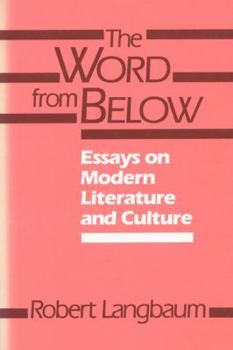
The Word from Below: Essays on Modern Literature and Culture

Langbaum has revised his 1970 collection of essays, The Modern Spirit; Essays on the Continuity of 19th and 20th Century Literature deleting some essays, revising and updating others, and adding five... This description may be from another edition of this product.
Format:Paperback
Language:English
ISBN:0299111849
ISBN13:9780299111847
Release Date:January 1987
Publisher:Univ of Wisconsin Pr
Length:240 Pages
Weight:0.25 lbs.
Dimensions:9.3" x 0.8" x 6.3"
Customer Reviews
1 rating
Word Up
Published by Thriftbooks.com User , 18 years ago
"The Word from Below" is a fine book of interesting, vital literary criticism. It's a real breath of fresh air, for Langbaum has the confidence in his own literary judgment to discuss and express his thoughts on literature in beautifully clear prose that's a pleasure to read in itself--no postmodern jargon, no citations from theory critics misused as premises or proofs, no radically-leftist snobbery. Not that he's got his head stuck in the sand. Several passages show that he is more than aware of this type of criticism and of its strengths and weaknesses, but he has his own priorities. If I had to express it in a nutshell, he's interested in tracing a new form of modern spirituality in literature, one characterized by moments of aesthetic epiphany triggered in the individual by contemplating nature--one that finds the sacred within such subjective psychological states instead of in a god "out there" somewhere. This tendency has its roots in the Romantic movement in poetry, especially with Wordsworth, and develops in diverse ways: Browning's poetic monologues, Modernist poetry and fiction (Joyce after all coined the term "epiphany" in the sense used here), even the historical fiction of Norman Mailer of all things. And if you think of cold scientific theories like Darwinist evolution and Freudian psychology as challenging these kinds of humanistic, spiritualistic values in literature, Langbaum argues counter-intuitively and convincingly that instead they deepen and empower them, fortifying them with complexity and toughness. As Mr. Spock might say, fascinating! This is the way literary criticism should be done. Highly recommended. The essays included in this book are: 1. Freud and Sociobiology: Reflections on the Nature of Genius 2. Can We Still Talk about the Romantic Self? 3. The Epiphanic Mode in Wordsworth and Modern Literature 4. Wordsworth's Lyrical Characterizations 5. The Victorian Idea of Culture 6. Is Guido Saved? The Meaning of Browning's Conclusion to "The Ring and the Book" 7. Browning and the Question of Myth 8. A New Look at E.M. Forster 9. The Importance of Trilling's "The Liberal Imagination" 10. The New Nature Poetry 11. Mailer's New Style 12. Pound and Eliot
Copyright © 2026 Thriftbooks.com Terms of Use
| Privacy Policy | Do Not
Sell/Share My Personal Information | Cookie Policy | Cookie Preferences | Accessibility Statement
ThriftBooks® and the ThriftBooks® logo are registered trademarks of Thrift Books Global, LLC
ThriftBooks® and the ThriftBooks® logo are registered trademarks of Thrift Books Global, LLC
