


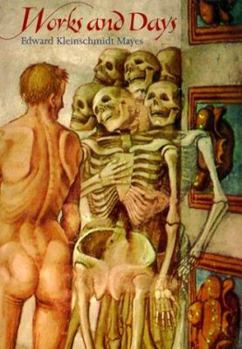
Works and Days (Pitt Poetry Series)


1999 AWP Winner
Edward Kleinschmidt Mayes carouses-playfully, deliciously-through the Italian countryside with his latest collection of poems. Like Hesiod's Works and Days, Mayes's collection explores the art of living and the transformations of one's life while working the land as a farmer. In his hand, the estatic and elegiac meet, shifting from a wide angle lens to the immediacy of the kitchen table, from Newton's revelations to the death of his parents.Written as an abecedarius, each poem's title begins with a different letter of the Italian alphabet, from Ago (needle) to Zappa (hoe). Often beginning a poem on the word that ended the last, he strings his readers along on denotation and double meaning-slight detours that take us from here to there, from Ovid shouting at his dog to our eternal quarrel with time. We follow this poet and his words, delighting in the movement, continually transported by sudden evocations of emotion that hit close to the heart. Mayes, known for his complex play with linguistic roots and for hard-driving tensile forms, extends his reach into the Italian language. As he farms his little plot of Tuscan soil, he introduces Italian phrases with a sense of wonder and pleasure, reminding us of our attraction for the word-imagination made flesh. He comes to realize that his "fields are poetry and olives" and his furrows and lines are seeded with Dante, and Virgil, Robert Johnson and Jussi Bjorling.
Edward Kleinschmidt Mayes carouses-playfully, deliciously-through the Italian countryside with his latest collection of poems. Like Hesiod's Works and Days, Mayes's collection explores the art of living and the transformations of one's life while working the land as a farmer. In his hand, the estatic and elegiac meet, shifting from a wide angle lens to the immediacy of the kitchen table, from Newton's revelations to the death of his parents.Written as an abecedarius, each poem's title begins with a different letter of the Italian alphabet, from Ago (needle) to Zappa (hoe). Often beginning a poem on the word that ended the last, he strings his readers along on denotation and double meaning-slight detours that take us from here to there, from Ovid shouting at his dog to our eternal quarrel with time. We follow this poet and his words, delighting in the movement, continually transported by sudden evocations of emotion that hit close to the heart. Mayes, known for his complex play with linguistic roots and for hard-driving tensile forms, extends his reach into the Italian language. As he farms his little plot of Tuscan soil, he introduces Italian phrases with a sense of wonder and pleasure, reminding us of our attraction for the word-imagination made flesh. He comes to realize that his "fields are poetry and olives" and his furrows and lines are seeded with Dante, and Virgil, Robert Johnson and Jussi Bjorling.
Format:Paperback
Language:English
ISBN:0822957086
ISBN13:9780822957089
Release Date:December 1999
Publisher:Univ of Pittsburgh Pr
Length:59 Pages
Weight:0.35 lbs.
Dimensions:8.5" x 0.3" x 6.0"
Related Subjects
PoetryCustomer Reviews
2 ratings
Not Hesiod but well worth your time
Published by Thriftbooks.com User , 23 years ago
This volume uses as raw material a number of things that rightly make a reader cautious - foreign words (Italian), many external references (Keats, Nero, Hesiod, Newton), an archaic format (acrostic). However, by the second poem the reader should recognize that they are in the hands of a master who uses the raw material to create his art not to impress the reader. Mayes has an unequalled ability to mix in a single poem classical Rome, blue collar America, academia, Italian farming, and Catholic imagery. In this mixture, one sees a unified and reflective life. Unlike most poetry I enjoy, Mayes' poetry does not have well-turned phrases or captivating images that cause certain lines to stand out. Rather, the poems have an internal consistency that discourages focus on individual pieces rather than the whole. Mayes is an uncommonly good contemporary poet, his work well worth getting to know.
Edward Klenschmidt Mayes' Works and Days
Published by Thriftbooks.com User , 25 years ago
Abecedarius is, according to The Princeton Encyclopedia of Poetry and Poetics' first entry, "a poem in which each line or stanza begins with a successive letter of the alphabet." In Works and Days, Mayes runs through the Italian alphabet not line by line, but poem by poem, from "Ago" to "Zappa." In addition, the first word of each poem begins with the same letter as the title and the last word of one poem becomes the title of the next poem.There's the risk that this scheme is too clever for the poetry's own good, but Mayes' craft comes across subtly, without detracting from the stuff of the lively poems. Despite the pattern, one can't predict where a poem will end up. The poem "Porca Miseria" (Pig Misery) leaps swiftly from the poet's father butchering a hog: "He talked about headcheese / into his eighties" -- to Ovid in exile: "He shouted to his dog / exactly what he himself wanted / to hear: vieni qua, Ovid, vieni qua." Mayes' poetic voice is distinguished by a quirky, tender humor. Hesiod's seventh century B.C. Works and Days seriously instructs the reader about such things as planting, plowing, footwear, and relieving the bladder. Mayes' version, on the other hand, treats its subjects playful. The instruction that opens the poem "Oliveto" (Olive) begins with a pun: "O / live, dammit, as if your life / depended on it, / I keep telling you.""My fields are poetry and olives" Mayes writes in "Macchina," with a double entendre on "fields." He turns words over and over as if plowing, as in the poem "Giorni" (Days): "Gather the melone,/small and sweet, hundreds of seeds in the wet center. Think of the seeds //the families have sown, have scattered. It has been all of us here who have / gathered, even casually, such as, I gather that // you're in a hurry, I gather that // this is the last time we'll see each other alive. It is I, talking, speaking correctly,/writing one last word followed by another last word. I somehow need to //gather darkness around me like the shield I want to be carried home on./When we gather, we recognize what we've gathered."Language, poetry, the Tuscan campi, these are the subjects Mayes celebrates. As he writes of Whitman in the poem "Erbaccia," (Weed) so may we write of him, "Perhaps / he thought the land the greatest / poem."
Copyright © 2026 Thriftbooks.com Terms of Use
| Privacy Policy | Do Not
Sell/Share My Personal Information | Cookie Policy | Cookie Preferences | Accessibility Statement
ThriftBooks® and the ThriftBooks® logo are registered trademarks of Thrift Books Global, LLC
ThriftBooks® and the ThriftBooks® logo are registered trademarks of Thrift Books Global, LLC
