


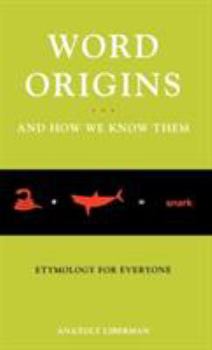
Word Origins ... and How We Know Them: Etymology for Everyone


Select Format
Select Condition 
Book Overview
"Millions of people want to know the origin of the words they use. Word columns in daily newspapers and numerous books attempt to satisfy their curiosity. Word histories are usually digested like pills: the user is interested in getting well, not in the chemistry of the prescribed medication. Those who send letters to the Editor also want a straight answer without bothering about how "editors" come by their knowledge. Therefore, they fail to realize that etymologies are seldom definitive and that the science of etymology is intensely interesting. Perhaps if someone explained to them that, compared to the drama of words, Hamlet is a light farce, they might develop a more informed attitude toward philological research and become students of historical linguistics rather than gullible consumers of journalists' pap."--Anatoly Liberman Word Origins is the only guide to the science and process of etymology for the layperson. This funny, charming, and conversational book not only tells the known origins of hundreds of words, but also shows how their origins were determined. Liberman, an internationally acclaimed etymologist, takes the reader by the hand and explains the many ways that English words can be made, and the many ways in which etymologists try to unearth the origins of words. Part history, part how-to, and completely entertaining, Word Origins invites readers behind the scenes to watch an etymologist at work.
Format:Hardcover
Language:English
ISBN:0195161475
ISBN13:9780195161472
Release Date:March 2005
Publisher:Oxford University Press
Length:320 Pages
Weight:1.11 lbs.
Dimensions:1.1" x 5.8" x 8.5"
Customer Reviews
3 ratings
The book is a good library copy with protective covering and arrived in a timely fashion.
Published by Thriftbooks.com User , 17 years ago
The book is a good library copy with protective covering and arrived in a timely fashion. It's a fascinating book, not quite as readable as other etymology books I have read, but offers good insights into how an etymologist does his or her work. It's a good book to read just before you go to sleep because it's interesting enough to hold your attention, but dry enough to put you to sleep.
Discovery rather than Consensus
Published by Thriftbooks.com User , 17 years ago
'Etymos/on' means 'true, real' in Greek, and etymologists endeavor to find the true origin of words. Right away we are on treacherous ground: one man's truth is another man's folly. Etymology deals with discovery, not with consensus, says Liberman. If you take the etymological explanations offered in standard dictionaries at face value (and look no further when it says "origin unknown"), you don't need this book. But let's say you come across a word like 'litter' which can have so many different meanings (scattered rubbish; stretcher; a number of young brought forth by a pig, cat, etc.; straw, hay or the like used as bedding for animals or protection for plants) you can't help wondering how this came about. (Hint: it all goes back to Latin 'lectus'=bed). Some word origins are quite transparent: it is easy to recognize 'day's eye' in 'daisy'. Onomatopoeic words like clap. flap, swish, buzz, etc. require no difficult analysis. But how is the nail on your finger or toe related to the metal object you hit with a hammer? Thus we find ourselves in the thicket of etymological research before we quite know how we got there. How the discipline developed, how it waxed and waned through the centuries and in different countries is a fascinating tale in itself. "Etymology finds its justification in the belief that words are not arbitrary but meaningful combinations of sounds", says the author. After leading us through various decoding efforts - some gratifyingly successful, others disconcertingly inconclusive - he sheds some light on the methods of etymology, and then gives an overview of the Indo-European sound shifts, Grimm's Law, and the nitty-gritty of historical linguistics. But just when we think we are on solid ground again, we are confronted with multiple violations and exceptions to these rules, and certainty once again yields to doubt. A treasure trove of references in different languages is incorporated in the notes; they reflect the fierce battles that have been going on between scholars and rival factions and are definitely worth reading alongside the text. (Some typos are distracting - Greek nu confused with upsilon, misplaced hyphens - but they don't spoil the fun). Liberman has tried to "combine entertainment with instruction", and I think he has succeeded admirably with this book. It does not reek of pedantry, yet manages to sneak in a lot of serious knowledge while maintaining a light, conversational tone. When, at the end, the author invites his readers "to leaf through this book again", you know that you will enjoy it even more the second time around.
word origins
Published by Thriftbooks.com User , 19 years ago
very interesting to really know the origins of the many words and phrases we use in every day language...I sure have more respect for the phrases being used.
Copyright © 2026 Thriftbooks.com
Terms of Use | Privacy Policy | Do Not Sell/Share My Personal Information | Cookie Notice | Cookie Preferences | Accessibility Statement
ThriftBooks ® and the ThriftBooks ® logo are registered trademarks of Thrift Books Global, LLC
ThriftBooks ® and the ThriftBooks ® logo are registered trademarks of Thrift Books Global, LLC
