


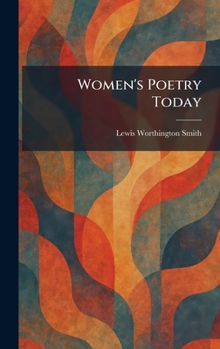
Women's Poetry Today

"Women's Poetry to-Day" is a significant early twentieth-century survey and anthology that captures the evolving landscape of female literary expression. Compiled during a period of great artistic transition, this work highlights the diverse voices and stylistic innovations of women poets who were redefining the boundaries of verse. The collection includes a broad range of thematic explorations, from intimate lyrical reflections to bold social observations, reflecting the complex intellectual and emotional lives of women in the early 1900s.
The volume serves as both a curated gallery of contemporary talent and a critical examination of the trends shaping modern poetry. By bringing together these works, the book provides a vital snapshot of the literary achievements of women during a transformative era. "Women's Poetry to-Day" remains an essential resource for those interested in the history of women's writing and the development of modern literature, offering a rich tapestry of voices that continue to offer insight into the feminine perspective and the enduring power of the written word. Its historical value lies in its preservation of these distinct poetic voices at a moment of significant cultural shifts.
This work has been selected by scholars as being culturally important, and is part of the knowledge base of civilization as we know it. This work was reproduced from the original artifact, and remains as true to the original work as possible. Therefore, you may see the original copyright references, library stamps (as most of these works have been housed in our most important libraries around the world), and other notations in the work.
This work is in the public domain in the United States of America, and possibly other nations. Within the United States, you may freely copy and distribute this work, as no entity (individual or corporate) has a copyright on the body of the work.
As a reproduction of a historical artifact, this work may contain missing or blurred pages, poor pictures, errant marks, etc. Scholars believe, and we concur, that this work is important enough to be preserved, reproduced, and made generally available to the public. We appreciate your support of the preservation process, and thank you for being an important part of keeping this knowledge alive and relevant.
Customer Reviews
ThriftBooks ® and the ThriftBooks ® logo are registered trademarks of Thrift Books Global, LLC
