


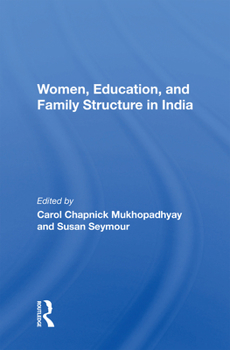
Women, Education, And Family Structure In India
No Customer Reviews

Select Format
Select Condition 
Book Overview
Five decades of independence have produced dramatic increases in womens' educational achievements in India; but education for girls beyond a certain level is still perceived as socially risky. Contributors probe the complex relationships between traditional Indian social institutions the joint family, arranged marriage, dowry and purdah, or sexual segregation and girls schooling.
Format:Paperback
Language:English
ISBN:0367217376
ISBN13:9780367217372
Release Date:June 2022
Publisher:Routledge
Length:256 Pages
Weight:0.77 lbs.
Dimensions:0.5" x 6.0" x 9.0"
Customer Reviews
0 rating
Copyright © 2026 Thriftbooks.com
Terms of Use | Privacy Policy | Do Not Sell/Share My Personal Information | Cookie Policy | Cookie Preferences | Accessibility Statement
ThriftBooks ® and the ThriftBooks ® logo are registered trademarks of Thrift Books Global, LLC
ThriftBooks ® and the ThriftBooks ® logo are registered trademarks of Thrift Books Global, LLC
