


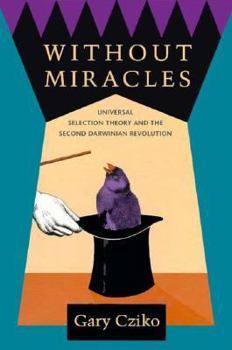
Without Miracles: Universal Selection Theory and the Second Darwinian Revolution

Select Format
Select Condition 
Book Overview
This text provides an account of the emergence of fit, integrating numerous scientific disciplines within the perspective of a universal selection theory that attempts to account for all cases of fit involving living organisms.
Format:Hardcover
Language:English
ISBN:0262032325
ISBN13:9780262032322
Release Date:January 1995
Publisher:Mit Pr
Length:385 Pages
Weight:1.76 lbs.
Dimensions:9.3" x 1.0" x 6.3"
Customer Reviews
4 ratings
FULL? VERISON ONLINE
Published by Thriftbooks.com User , 21 years ago
This book can be found at http://faculty.ed.uiuc.edu/g-cziko/wm/
Deceptively simple process generates beauty!
Published by Thriftbooks.com User , 24 years ago
That applies to this book, as well as the concepts described herein. When a book can alter your perception and understanding of the world for the better you reread it. I'm currently on my third formal reading of this masterpiece. I go back to it often. Cziko has brought to life the simple but powerful concept that Campbell called evolutionary epistemology: blind variation and selection. I use these concepts in everyday life (risk-taking, creativity, trade-off decision-making). Even if not useful, the concept would enegender admiration for its sheer beauty. The fact that it can be useful and fun is an added benefit.
A Must! But far from flawless...
Published by Thriftbooks.com User , 24 years ago
This book is surely a must for anyone interested in phylosophical discussions concerning "darwinian" (or better, neo-darwinian) evolution theory, and its potential to explain other fields where any kind of innovation is created. The author describes these innovations as "puzzles of fit" of an organism or of a system to another organism or system, and he brilliantly equals all these "fits" to "knowledge". Cziko reached a good level of quality in his transdisciplinary approach, putting together data from fields like evolutionary biology, immunology, neurobiology, animal and human learning, human thought and language, scientific knowledge growth, and cultural adaptation. For this, he no doubt deserves a four-star ranking. But then, there come the flaws...The central issue in the book is that just any kind of innovation, puzzle of fit, knowledge growth, or whatever you call it, can only be achieved through a process very much like biological evolution as accepted by the neo-darwinian paradigm: cumulative blind variation followed by the survival of the fittest. Cziko also shows how explanations for these puzzles of fit have evolved in all fields from providential explanations (like in the book of Genesis, where things happened to achieve a pourpose previously devised), through instructionist ones (like Lamarck's "Use and Disuse" plus "Inheritance of Acquired Characters", where the environment would "force" the individual creatures to change just in the right, successful way, and then the creatures would pass these changes on to their offsprings), and finally to selectionist ones (Darwin's Selection Theory). He says that only selectionist explanations can give truly "scientific" and "naturalistic" accounts for these fits, without recoursing to miraculous schemes. In short: Cziko brings us the good news that not only are we merely machines (like we have feared ever since the mechanical physics of Newton), but we are blind ones too!The starting point of his reasoning is evolutionary biology, and Cziko's understanding of it seems to me too narrow-minded, with a strong bias toward the old notions of New-Darwinism. Consequently, his report and deductions on it are misinformative. Evolution was (and, to a large extent, still is) thought to be based on "variation and survival of the fittest". But in the past the view of the causes of these variations were believed to be basically errors: DNA damage by the environment, and failure of the organism to correct damages or to make precise copies of the DNA. It's been a long time now that this view has changed dramatically, and organisms, even as simple as bacteria, are now known (from before 1990) to possess amazing control over the ways and the contexts in which these variations happen. They can trigger DNA mutation under appropriate conditions (stress, threats to survival), and even control which areas of the genome will be subject to change. This renders organisms much more "smartly" interactive with the enviro
A brilliant tour de force
Published by Thriftbooks.com User , 24 years ago
We all know about the theory of evolution by natural selection, but what I didn't know was that this idea could be extended to any field in which something new is produced. Cziko brilliantly reviews the application of selection theory (blind variation followed by selection of best fits) to fields as different as neurology, immunology, linguistics, education, pharmacology and artificial intelligence, and presents a strong argument for the claim that innovation in any field can only arise through an application of selection theory. How does our immune system deal with a potentially infinite variety of antigens? Not directly through information contained in the genes, which are quite limited in number. Not through direct copying of the shapes of antigens, since no mechanism allows it to copy an infinite number of potential shapes. Rather, sequential generations of B lymphocytes produce antibodies that fit the antigen better and better, with continual selection of the B lymphocytes that produce the best-fitting antibodies. How do we acquire new knowledge? It is not innate, as Plato claimed. And we don't directly "learn" it from others, except in the sense that a parrot learns. Rather, we are constantly trying to make better and better sense of our perceptions, by building better and better explanations in our minds and rejecting inadequate explanations. Information and instruction received from others are only perceptions to us until we have incorporated them into our own explanatory schemes. So "learning" is actually an active process of explanation-building through trial and error, in other words, a form of blind variation of explanatory schemes and selection of the best ones.This book is well-written, clear, and immensely "instructive", causing me to modify a number of explanatory schemes in my own mind. I put it alongside the best of Dawkins, Dennett and Wilson. It should have a much wider readership than it apparently has.
Copyright © 2026 Thriftbooks.com Terms of Use
| Privacy Policy | Do Not
Sell/Share My Personal Information | Cookie Policy | Cookie Preferences | Accessibility Statement
ThriftBooks® and the ThriftBooks® logo are registered trademarks of Thrift Books Global, LLC
ThriftBooks® and the ThriftBooks® logo are registered trademarks of Thrift Books Global, LLC
