


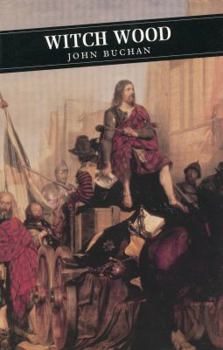
Witch Wood


Select Format
Select Condition 
Book Overview
Set against the religious struggles of seventeenth-century Scotland, with Montrose for the king against a convenanted kirk, John Buchan's Witch Wood is a gripping atmospheric tale in the spirit of Stevenson and Neil Munro. As a moderate Presbyterian minister, young David Sempill disputes with the extremists of his faith. All around, the defeated remnants of Montrose's men are being harried and slaughtered by the faithful, and Sempill's plea for compassion, like his love for the beautiful Katrine Yester, is out of joint with the times. There are still older conflicts to be faced however, symbolised by the presence of the Melanudrigill Wood, a last remnant of the ancient Caledonian forest. Here there is black magic to be uncovered, but also the more positive pre-Christian intimations of nature worship. In such setting, and faced with the onset of the plague, David Sempill's struggle and eventual disappearance take on a strange and timeless aspect in what was John Buchan's own favourite among his many novels.
Format:Paperback
Language:English
ISBN:0862412021
ISBN13:9780862412029
Release Date:January 2001
Publisher:Canongate Books
Length:312 Pages
Weight:0.58 lbs.
Dimensions:0.8" x 5.0" x 7.8"
Customer Reviews
3 ratings
The Beauty of Sacrificial Love
Published by Thriftbooks.com User , 18 years ago
Strange things haunt the woods. Stranger things haunt the human heart. Rev. David Semphill does battle with both. Feint-hearted professions are commonplace. The blindness is willful. Preoccupied with the English Civil Wars and upholding the Solemn League and Covenant, Semphill's Scottish Presbytery ignores his pleas for help. Eventually, they turn against him, leaving the young minister alone in his battle with the Paganism that grips his parish. In its attempt to destroy both, Hypocrisy masquerades as truth and beauty. Buchan's novel pulls away the veil, revealing, especially through Semphill's personal struggles, the ugliness of hypocrisy and the beauty of unreserved, sacrificial love.
Surprisingly Good
Published by Thriftbooks.com User , 21 years ago
Buchan is best known today as the author of the espionage thriller, The 39 Steps, though more people have probably seen the Hitchcock movie version than read the book. Readers expecting something similar to 39 Steps or Buchan's other thrillers will be disappointed by Witch Wood. This is, however, a better book than the thrillers. Buchan patterned Witch Wood after Robert Louis Stevenson historical novels like Kidnapped or The Master of Ballantrae, books which take a human issue and the historical setting seriously. Set in 17th century lowland Scotland, the hero of Witch Wood is a young and idealistic Presbyterian minister. This book, which has adventure elements, is essentially a story of conflicts of conscience faced by the hero. Buchan was the son of a Presbyterian minister, had a strong interest in church history, and at one point in his public career, was directly involved in the affairs of the Church of Scotland. I suspect as well that elements are based on his own boyhood. While aspects of the plot are a bit contrived and some parts anachronistic, Buchan really does well in making something human and interesting out of the doctrinal politics and theology of Presbyterianism at this time.
C. S. Lewis said: "That's the way to do it"
Published by Thriftbooks.com User , 21 years ago
C. S. Lewis liked this novel so much that he sent the author a fan letter, stating his appreciation for Buchan's novels but speaking especially of his gratitude for Witch Wood. Lewis commended the skilful buildup of atmosphere. You can find this Lewisian nugget in Janet Adam Smith's John Buchan and His World. As for myself - - I suppose I have read this novel three times, with much enjoyment.
Copyright © 2026 Thriftbooks.com
Terms of Use | Privacy Policy | Do Not Sell/Share My Personal Information | Cookie Policy | Cookie Preferences | Accessibility Statement
ThriftBooks ® and the ThriftBooks ® logo are registered trademarks of Thrift Books Global, LLC
ThriftBooks ® and the ThriftBooks ® logo are registered trademarks of Thrift Books Global, LLC
