


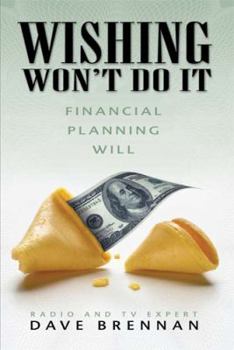
Wishing Won't Do It: Financial Planning Will

Each year Americans spend more time planning their vacations than planning for their retirement. We?re obsessive about acquiring the latest electronic gadget, while we buy bigger and bigger vehicles.... This description may be from another edition of this product.
Format:Hardcover
Language:English
ISBN:1934812110
ISBN13:9781934812112
Release Date:August 2008
Publisher:Brown Books Publishing Group
Length:152 Pages
Weight:0.95 lbs.
Dimensions:9.0" x 0.8" x 5.8"
Customer Reviews
4 ratings
Excellent
Published by Thriftbooks.com User , 17 years ago
I wish I had read this type of book when I was in my early twenties. Back then, it seemed to me as though I would have a lifetime to worry about money issues and that my 20's were about enjoying myself. Unfortunately, I spent wayyy too much and way into my 30's. So I am the perfect target audience for the book Wishing Won't do it. After reading the title, it made me think and I have to admit that, for most of my life, I somehow just believed that the money would "just" appear by magic when I needed it. Author Brennan takes a very honest look at how we, as humans, take a look at money. For the most part, we don't understand it, are intimidated by it, let it lead us and basically see it as a base of some kind of superpower. One of the more important chapters in this book is about reducing debt. This, I believe, is the root of ALL evil - Brennan quotes staggering numbers of people in debt and the amount they owe is amazing. Of course, with what is happening in our world today, we all get a very good firsthand look at the woes too much credit has created, but it amazes me just how far reaching these woes actually are! Brennan also takes a very interesting look at how our generation's view of money differs so much from the previous generations - short term gratification!!!! This book basically covers off most personal finance aspects we may be encountering. I really liked the section Planning for your Retirement - which, in my opinion, is invaluable for those boomers! What I liked so much about this book is that it is written for the average person - the terms are easily understandable and the message is clear and honest. This book is also scary to read, especially in our present economic situation - and although Brennan's message is pretty much the same as many other personal finance authors - it still sends a chill through me- "get your act together NOW or you will end up struggling in your retirement years". I suggest this book to young adults, older adults and anyone in between - its a wake up call - that is for sure!
Wishing Really Won't Do It!
Published by Thriftbooks.com User , 17 years ago
Anyone, including young adults, should read this book. Even if you don't want to be in the stock market, you will understand everything you need to know about it. If you are in the stock market or intend to be, it's a must read!
Excellent Information
Published by Thriftbooks.com User , 17 years ago
The author takes some very complex topics and turns into a very enjoyable book. Extremely easy to read and provides information that can be passed on to every member of your family. My wife and I have begun teaching the simple lessons in this book to our children to help educate them about the most fundamental principles of their financial future. A great read for all ages.
What are you waiting for?
Published by Thriftbooks.com User , 17 years ago
While many Americans want to be free of debt and experience financial success, most openly admit they have no idea how to achieve it. In this volume, Dave Brennan shares several of his insights concerning the challenges and rewards of effective money management. Those who have far greater knowledge about economics than do I will find no head-snapping revelations in this book, nor does Brennan make any such claim. However, those same people would be well-advised to consider purchasing a copy for each of their children and, if and when appropriate, for each of their grandchildren. I also think that all school and college students should carefully consider what Brennan has to say about money management so that they can avoid many of the serious problems they and their classmates have already encountered or will encounter such as credit card debt, overdraft charges on returned checks, and having to "borrow" from family members. It seems reasonable to correlate personal financial crises that many citizens have with the financial crises their elected officials seem unable to resolve. For example, on a national level Brennan presents the critical material for the reader to consider if our country is on the verge of financial collapse from the unimaginable Federal debt of $9.5-trillion. Readers should not be put off by the term "financial planning." All of us are constantly making personal plans of various kinds such as what to do on a Saturday evening or what to wear at a social event. The same is true for students who must meet different obligations within a fixed schedule (e.g. when a class meets, when the team departs for an away game, deadlines for homework assignments) and the same is true for those with full-time jobs, most of whose assigned tasks have deadlines and others depend on a timely completion. IBM trains its executives to "plan their work and work their plan." Many employers require their workers to arrive by a set time and allow them to depart only at another set time. The key point is that almost all people who now have serious financial problems already have basic skills in making plans that involve personal decisions and tasks and apply many of these same skills when planning what they do to earn a living. What many lack, however, is the advice they need --and the advice Brennan offers in this book -- to apply these skills when addressing their financial problems. However, as Brennan acknowledges, there are several challenges that many (most?) people find very difficult to overcome. Instant gratification, for example. Rather than delay a purchase until sufficient funds have been saved, many consumers prefer to use a charge card and thus have what they want NOW. What they do not realize is that, when doing so, they have added anywhere from 5-20% to the cost, depending on the prevailing interest charge and the extent to which there is an unpaid balance on the credit card. As Brennan explains, compound interest is a double-edge sw
Copyright © 2026 Thriftbooks.com Terms of Use
| Privacy Policy | Do Not
Sell/Share My Personal Information | Cookie Policy | Cookie Preferences | Accessibility Statement
ThriftBooks® and the ThriftBooks® logo are registered trademarks of Thrift Books Global, LLC
ThriftBooks® and the ThriftBooks® logo are registered trademarks of Thrift Books Global, LLC
