


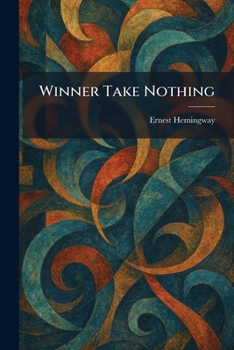
Winner Take Nothing


Select Format
Select Condition 
Book Overview
"Winner Take Nothing" is a compelling collection of short stories that exemplifies the minimalist style and thematic intensity of Ernest Hemingway. Through a series of fourteen narratives, the work explores the darker corners of the human psyche, touching upon themes of loneliness, failure, and the search for meaning in a chaotic world. Included in this collection are some of the author's most acclaimed pieces, such as "A Clean, Well-Lighted Place" and "The Light of the World," which demonstrate his mastery of the short form and his unique ability to convey profound emotion through sparse dialogue and precise observation.
The stories within "Winner Take Nothing" are populated by characters grappling with physical and emotional wounds, reflecting the disillusionment of the era. Hemingway's prose captures the stoic endurance required to face life's hardships, providing a poignant look at individuals who find themselves at odds with their surroundings. This collection serves as an essential exploration of the American literary landscape, offering a timeless meditation on the nature of loss and the resilience of the human spirit.
This work has been selected by scholars as being culturally important, and is part of the knowledge base of civilization as we know it. This work was reproduced from the original artifact, and remains as true to the original work as possible. Therefore, you may see the original copyright references, library stamps (as most of these works have been housed in our most important libraries around the world), and other notations in the work.
This work is in the public domain in the United States of America, and possibly other nations. Within the United States, you may freely copy and distribute this work, as no entity (individual or corporate) has a copyright on the body of the work.
As a reproduction of a historical artifact, this work may contain missing or blurred pages, poor pictures, errant marks, etc. Scholars believe, and we concur, that this work is important enough to be preserved, reproduced, and made generally available to the public. We appreciate your support of the preservation process, and thank you for being an important part of keeping this knowledge alive and relevant.
Customer Reviews
A guidebook to the imagination
Gain nothing, lose nothing
ThriftBooks ® and the ThriftBooks ® logo are registered trademarks of Thrift Books Global, LLC
