


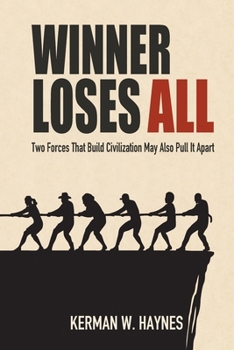
WINNER LOSES ALL: Two Forces That Build Civilization May Also Pull It Apart

Civilizations may not break because no one can see danger. They may break because different people see opposite dangers-and teach each other to become right.
Every durable society depends on two forces. The generative force opens possibility: it experiments, invents, crosses frontiers, and acts before permission has fully formed. The consolidating force makes achievement dependable: it builds standards, institutions, professions, records, and rules that allow knowledge to survive and strangers to coordinate. Civilization needs both.
But every successful answer changes the problem. What began as protection can harden into control. What began as liberation can outrun the structures that make freedom survivable. As mature systems become more interconnected, exits narrow and ordinary life depends on layers of credentials, classifications, approvals, and inherited authority. Then pressure rises. One group sees rigidity and pushes harder for release. Another sees disorder and tightens its grip. Each response becomes fresh evidence that the other side was dangerous all along.
Winner Loses All follows this pattern across invention, business, the American frontier, public institutions, factional conflict, and the arrival of artificial intelligence. Along the way, Kerman W. Haynes develops a plain-language model of generative and consolidating human orientations, the high-intensity interpreters who detect weak signals before others do, and the feedback loop that can turn useful differences into hostile identities.
The book's central image is a tug-of-war unlike the one either team imagines. There is a cliff behind each side. On one edge lies fragmentation: change moving faster than legitimacy, coordination, and trust can follow. On the other lies rigidity: a system preserving its existing architecture so completely that it loses the capacity to adapt. The rope is the shared civilization. If either side wins absolutely, its victory may pull the winner backward over its own cliff.
This is not a partisan diagnosis, an attack on expertise, or a romantic defense of rebellion. Rules and institutions contain stored judgment-the accumulated learning that makes complex life possible. Yet stored judgment cannot permanently replace living judgment, because reality keeps changing. Agency is not refusing knowledge or authority; it is remaining the author of one's conclusion while deciding what deserves reliance, what has been delegated, and what would justify reconsideration.
Haynes does not exempt his own theory from that standard. He revises part of it in full view, identifies where the model may fail, and asks readers to attack, measure, and test what he believes he is seeing. The result is both a diagnosis of a civilization under pressure and an invitation to notice the danger your own instincts may hide from you.
The question is not which force civilization can finally eliminate. It is whether we can preserve what works, reopen what has hardened, and change the amount of force in our hands before there is a final winner.
Customer Reviews
ThriftBooks ® and the ThriftBooks ® logo are registered trademarks of Thrift Books Global, LLC
