


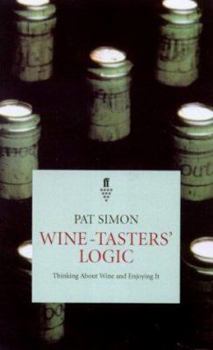
Wine-Taster's Logic: Thinking About Wine - And Enjoying It (Faber Books on Wine)


Pat Simon has been a master of wine for more than thirty years, acquiring an extensive knowledge of types of wine and of wine-making techniques. In this book he draws on his experience to cover a vast... This description may be from another edition of this product.
Format:Paperback
Language:English
ISBN:057120287X
ISBN13:9780571202874
Release Date:January 1
Publisher:Faber & Faber, Incorporated
Length:199 Pages
Weight:0.50 lbs.
Dimensions:8.5" x 0.8" x 5.5"
Customer Reviews
3 ratings
Highly individual contribution for the advanced learner
Published by Thriftbooks.com User , 25 years ago
Wine taster logicThis book is not an introduction to wine. It goes beyond common sense and nonsense and is a highly individual contribution. The author writes from his extraordinary experience in the wine trade and commercial considerations are frequently present. Inspiring and daring suggestions (like the possible explanation of the mellow character of mature red wine) are most interesting. Historical remarks on the sometimes lost original meanings of standard tasting vocabulary terms are excellent. On the minus side, the introduction of Gestalt Psychologie to the consideration of the shape of wine seems to me to be less than solid. The book is not a systematic treatise and the title does not seem to fit the content very well. A unique contribution for fairly advanced learners.
Excellent
Published by Thriftbooks.com User , 26 years ago
This book is excellent because it is very accurate, and at the same time very enjoyable. For once, a book aimed at people who know and appreciate wine, but surely a source of valuable information for passionate beginners.
Excellent book for intermediate wine lovers
Published by Thriftbooks.com User , 26 years ago
Pat Simon was educated in Norfolk, France and Cambridge, and spent World War II with the Royal Artillery and at Montgomery's headquarters. He entered the wine trade in 1948, and served as director of a number of companies in the wine and liquor business. He became one of the first Masters of Wine in 1966, and has taught and written about wine for many years. This book is a summing up of his over fifty years in the business, and covers a great deal of territory in a straight forward and enjoyable manner. Jamie Goode, author of the outstanding The Science of Wine: From Vine to Glass, wrote on his website: "Fifty years in the wine business have equipped Pat Simon with a nose and palate of formidable finesse. His ruminations on how a taster learns to taste, how memory and appreciation are deepened, and how the intensely subjective experience of tasting wine can be communicated meaningfully, are distilled in Wine-Taster's Logic." Part One covers the theory of tasting, and in short chapters Simon discusses tannin sensing, climate, ambience, aromas, wine words, tasting skills and balancing, among a number of other topics. Part Two is a more practical guide to developing tasting skills and focusing on oxidization, acidities, balance, tannin, concentration, practicing decanting, and writing tasting notes. Throughout Simon refers to wine writers and tasters that he has met, and describes several of his adventures in the wine business. This is an excellent book for an intermediate wine lover. A few extracts I found interesting: "In sake tasting they use a fifth term - umami - which is usually translated as `deliciousness'. It is now defined in the ISO vocabulary as the taste of mono-sodium glutamate." "It is sometimes helpful to make a slight pause when approaching one's nose to the glass: the French us the word `montant' to describe how certain wines come up out of the glass to meet you." "Slow Motion Thinking. One of the things that particularly confused me when I was first learning to taste was the way all the perceptions seemed to come together in a rush. Jules Chauvet suggested to me that if one could accept (at least in theory) that aromas might be arriving in a time sequence - and not all at once - it might be possible for the mind to record them all, and then give one a slow motion playback. I found that it helped me to trick my mind into playing this kind of game if I though of the aromas coming off [in a kind of hierarchy -- Flower - fruit - spice - herbs - vegetal - soil notes --], and I would then be able to note their presence or absence from the awaited sequence." "The word `vintage' in English has two meanings: the grape harvest and the year in which a particular wine was made. The French, however, make a distinction between the `vendange', the grape harvest, and `millésime', the year of the wine. Similarly in Germany: `Weinlese' and `Jahrgang'." Many of his discussions are worth considering, for example: how and why to chew tannins,
Copyright © 2026 Thriftbooks.com
Terms of Use | Privacy Policy | Do Not Sell/Share My Personal Information | Cookie Policy | Cookie Preferences | Accessibility Statement
ThriftBooks ® and the ThriftBooks ® logo are registered trademarks of Thrift Books Global, LLC
ThriftBooks ® and the ThriftBooks ® logo are registered trademarks of Thrift Books Global, LLC
