


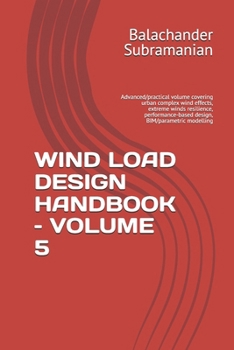
Wind Load Design Handbook - Volume 5: Advanced/practical volume covering urban complex wind effects, extreme winds resilience, performance-based desig
No Customer Reviews

WIND LOAD DESIGN HANDBOOK - VOLUME 5 Advanced Wind Analysis, Extreme Events, Digital Engineering, Optimization and Integrated Design Practice
Wind-resistant design is no longer simply a matter of calculating a pressure and applying it to a structural model.
Modern buildings interact with complex urban environments, turbulent atmospheric flow, neighboring structures, flexible structural systems, sophisticated fa ades, extreme wind events, digital models, and changing environmental conditions. Successful wind engineering therefore requires an integrated understanding of aerodynamics, structural dynamics, envelope performance, human comfort, resilience, advanced analysis, optimization, and lifecycle performance. Wind Load Design Handbook - Volume 5 brings these advanced subjects together in a practical engineering framework.
The volume begins with wind engineering for urban and complex building configurations, addressing building interference, urban canyons, tower clusters, podiums, setbacks, irregular forms, channeling, shielding, wake effects, and aerodynamic interactions. It then examines pedestrian-level wind and urban microclimate, including tower downwash, corner acceleration, wind comfort, safety, plazas, entrances, streets, landscaping, and mitigation strategies. The book progresses into extreme wind engineering and resilience, covering cyclones, hurricanes, typhoons, tornadoes, windborne debris, impact-resistant building envelopes, failure investigation, forensic engineering, robustness, and post-event resilience. Modern design methodologies receive equal attention. The volume explores performance-based wind design, probabilistic and reliability-based assessment, BIM, parametric modeling, artificial intelligence, machine learning, digital twins, automated workflows, aerodynamic optimization, sustainable structural design, embodied carbon, lifecycle performance, and resilience-oriented optimization. These methods are presented with a consistent emphasis on validation, uncertainty, quality control, and engineering judgment. Key FeaturesAdvanced urban wind engineeringPedestrian-level wind and microclimate analysisCyclone, hurricane and typhoon-resistant designTornado and extreme wind engineeringWindborne debris and impact-resistant designWind damage assessment and forensic investigationPerformance-based wind designReliability, uncertainty and risk-based assessmentBIM and parametric wind engineeringArtificial intelligence and digital twinsAerodynamic and structural optimizationSustainable and low-carbon wind-resistant structuresIntegrated worked examples and engineering case studiesWind tunnel and CFD applicationsConstruction-stage wind assessmentQuality assurance and independent verificationResilience, lifecycle performance and recovery planningDesigned for structural engineers, civil engineers, wind engineers, fa ade specialists, architects, contractors, engineering consultants, researchers, reviewers, educators, and advanced students, this volume is both a technical reference and a practical guide to modern wind engineering. At its heart is a simple principle:
Wind engineering is not merely the calculation of wind pressure. It is the design, verification, construction, operation, maintenance, and resilience of the entire system that interacts with wind. For professionals seeking to understand and apply advanced wind engineering to modern structures, Wind Load Design Handbook - Volume 5 provides a comprehensive bridge between theory, computation, testing, practical design, and engineering judgment.
Wind-resistant design is no longer simply a matter of calculating a pressure and applying it to a structural model.
Modern buildings interact with complex urban environments, turbulent atmospheric flow, neighboring structures, flexible structural systems, sophisticated fa ades, extreme wind events, digital models, and changing environmental conditions. Successful wind engineering therefore requires an integrated understanding of aerodynamics, structural dynamics, envelope performance, human comfort, resilience, advanced analysis, optimization, and lifecycle performance. Wind Load Design Handbook - Volume 5 brings these advanced subjects together in a practical engineering framework.
The volume begins with wind engineering for urban and complex building configurations, addressing building interference, urban canyons, tower clusters, podiums, setbacks, irregular forms, channeling, shielding, wake effects, and aerodynamic interactions. It then examines pedestrian-level wind and urban microclimate, including tower downwash, corner acceleration, wind comfort, safety, plazas, entrances, streets, landscaping, and mitigation strategies. The book progresses into extreme wind engineering and resilience, covering cyclones, hurricanes, typhoons, tornadoes, windborne debris, impact-resistant building envelopes, failure investigation, forensic engineering, robustness, and post-event resilience. Modern design methodologies receive equal attention. The volume explores performance-based wind design, probabilistic and reliability-based assessment, BIM, parametric modeling, artificial intelligence, machine learning, digital twins, automated workflows, aerodynamic optimization, sustainable structural design, embodied carbon, lifecycle performance, and resilience-oriented optimization. These methods are presented with a consistent emphasis on validation, uncertainty, quality control, and engineering judgment. Key FeaturesAdvanced urban wind engineeringPedestrian-level wind and microclimate analysisCyclone, hurricane and typhoon-resistant designTornado and extreme wind engineeringWindborne debris and impact-resistant designWind damage assessment and forensic investigationPerformance-based wind designReliability, uncertainty and risk-based assessmentBIM and parametric wind engineeringArtificial intelligence and digital twinsAerodynamic and structural optimizationSustainable and low-carbon wind-resistant structuresIntegrated worked examples and engineering case studiesWind tunnel and CFD applicationsConstruction-stage wind assessmentQuality assurance and independent verificationResilience, lifecycle performance and recovery planningDesigned for structural engineers, civil engineers, wind engineers, fa ade specialists, architects, contractors, engineering consultants, researchers, reviewers, educators, and advanced students, this volume is both a technical reference and a practical guide to modern wind engineering. At its heart is a simple principle:
Wind engineering is not merely the calculation of wind pressure. It is the design, verification, construction, operation, maintenance, and resilience of the entire system that interacts with wind. For professionals seeking to understand and apply advanced wind engineering to modern structures, Wind Load Design Handbook - Volume 5 provides a comprehensive bridge between theory, computation, testing, practical design, and engineering judgment.
Format:Paperback
Language:English
ISBN:B0HJ1TKV1X
ISBN13:9798172447259
Release Date:September 2026
Publisher:Independently Published
Length:766 Pages
Weight:2.22 lbs.
Dimensions:1.5" x 6.0" x 9.0"
Customer Reviews
0 rating
Copyright © 2026 Thriftbooks.com
Terms of Use | Privacy Policy | Do Not Sell/Share My Personal Information | Cookie Policy | Cookie Preferences | Accessibility Statement
ThriftBooks ® and the ThriftBooks ® logo are registered trademarks of Thrift Books Global, LLC
ThriftBooks ® and the ThriftBooks ® logo are registered trademarks of Thrift Books Global, LLC
