


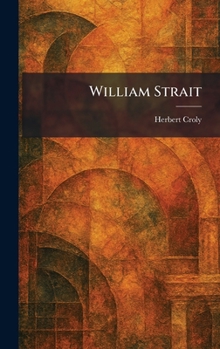
William Strait

"William Straight" is an insightful biography written by the influential political philosopher and journalist Herbert Croly. The work provides a detailed examination of the life and career of a man who stood at the crossroads of American diplomacy and global finance during the early 20th century. Croly captures the trajectory of an individual deeply involved in the economic and political opening of China, offering a window into the complexities of international relations and the emergence of the United States as a global power.
The narrative delves into the strategic maneuvers of investment banking and the professionalization of the American foreign service, illustrating how personal vision and national interest intertwined during a transformative era. Through this account, readers gain a better understanding of the cultural and political shifts that defined the period between the late Gilded Age and the aftermath of World War I. This biography remains a significant historical document, shedding light on the individuals who shaped modern diplomatic and financial landscapes.
This work has been selected by scholars as being culturally important, and is part of the knowledge base of civilization as we know it. This work was reproduced from the original artifact, and remains as true to the original work as possible. Therefore, you may see the original copyright references, library stamps (as most of these works have been housed in our most important libraries around the world), and other notations in the work.
This work is in the public domain in the United States of America, and possibly other nations. Within the United States, you may freely copy and distribute this work, as no entity (individual or corporate) has a copyright on the body of the work.
As a reproduction of a historical artifact, this work may contain missing or blurred pages, poor pictures, errant marks, etc. Scholars believe, and we concur, that this work is important enough to be preserved, reproduced, and made generally available to the public. We appreciate your support of the preservation process, and thank you for being an important part of keeping this knowledge alive and relevant.
Customer Reviews
ThriftBooks ® and the ThriftBooks ® logo are registered trademarks of Thrift Books Global, LLC
