


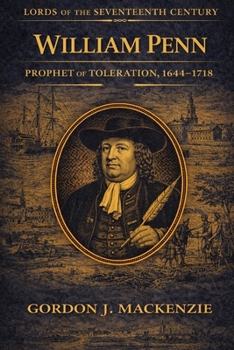
William Penn: Prophet of Toleration

William Penn was not a king, a general, or a minister of state, yet his ideas reshaped the political and religious future of the Atlantic world. Born into privilege and drawn into radical dissent, Penn became one of the most influential figures of the seventeenth century by insisting that conscience could not be governed by force.
In an age defined by civil war, religious persecution, and absolute claims of authority, Penn stood apart. As a committed Quaker, he rejected violence, oaths, and coercion, even as England cracked down on religious nonconformity. Arrested, imprisoned, and publicly vilified, Penn transformed persecution into principle, arguing that liberty of conscience was not a threat to order but its foundation.
This book traces Penn's journey from the turbulent politics of Restoration England to the founding of Pennsylvania, an unprecedented experiment in religious toleration, representative government, and peaceful coexistence. Drawing on Penn's political writings, court battles, and colonial vision, it reveals how his ideas challenged both Crown and Parliament while offering a radically different model of authority.
Penn's legacy is not one of rebellion, but of restraint. He believed power should be limited, law grounded in consent, and government judged by how it protects the vulnerable. In a century scarred by absolutism and sectarian violence, William Penn proposed something rare: a society governed by law rather than fear.
Written in clear, narrative prose, William Penn places him among the defining figures of the seventeenth century and shows how his vision helped shape the modern world.
Customer Reviews
ThriftBooks® and the ThriftBooks® logo are registered trademarks of Thrift Books Global, LLC
