


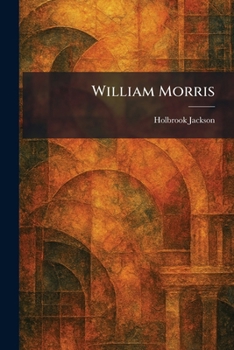
William Morris

Select Format
Select Condition 
Book Overview
"William Morris" by Holbrook Jackson is a comprehensive examination of the life, thought, and artistic legacy of one of the most influential figures of the Victorian age. As a central force behind the Arts and Crafts Movement, Morris's work spanned poetry, textile design, and political activism, leaving an indelible mark on both the aesthetic and social landscapes of his time.
In this insightful study, Jackson explores Morris's multifaceted career, from his early associations with the Pre-Raphaelite Brotherhood to his development as a pioneer of modern design and a passionate advocate for socialist ideals. The narrative highlights his belief in the dignity of manual labor and the necessity of beauty in everyday life, detailing his contributions to the Kelmscott Press and his revolutionary approaches to craftsmanship. Jackson effectively situates Morris within the broader context of 19th-century intellectual history, illustrating how his vision for a more equitable and beautiful world continues to resonate. For readers interested in the intersection of art, politics, and literature, this work offers a definitive portrait of a man whose creative genius and social conscience helped shape the modern world.
This work has been selected by scholars as being culturally important, and is part of the knowledge base of civilization as we know it. This work was reproduced from the original artifact, and remains as true to the original work as possible. Therefore, you may see the original copyright references, library stamps (as most of these works have been housed in our most important libraries around the world), and other notations in the work.
This work is in the public domain in the United States of America, and possibly other nations. Within the United States, you may freely copy and distribute this work, as no entity (individual or corporate) has a copyright on the body of the work.
As a reproduction of a historical artifact, this work may contain missing or blurred pages, poor pictures, errant marks, etc. Scholars believe, and we concur, that this work is important enough to be preserved, reproduced, and made generally available to the public. We appreciate your support of the preservation process, and thank you for being an important part of keeping this knowledge alive and relevant.
Customer Reviews
ThriftBooks® and the ThriftBooks® logo are registered trademarks of Thrift Books Global, LLC
