


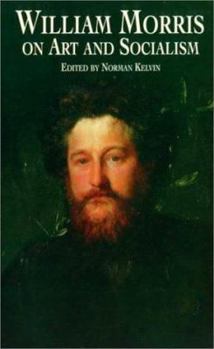
William Morris on Art and Socialism


For the Victorian sage William Morris, the subjects of art and society were inseparable. This outstanding collection of 11 lectures and an essay illustrates Morris s convictions. Includes: "Art: A... This description may be from another edition of this product.
Format:Paperback
Language:English
ISBN:048640904X
ISBN13:9780486409047
Release Date:August 1999
Publisher:Dover Publications, Incorporated
Length:208 Pages
Weight:0.50 lbs.
Dimensions:0.4" x 5.3" x 8.4"
Customer Reviews
1 rating
Eleven Essays: Draw Your Own Conclusions
Published by Thriftbooks.com User , 16 years ago
In WILLIAM MORRIS, Norman Kelvin edits eleven essays given by Morris over a period of several years, most of which deal with his view that art ought to somehow be above the sordid details of life. Several of his essays also relate to Morris' late in life conversion to Socialism. English prose writers of the mid and late nineteenth century tended to focus on the humanistic ideals of the age. For Matthew Arnold, these ideals related to culture in the abstract. For John Henry Newman, it was to establish the parameters of the Anglican Church. And for William Morris, it was the fixing of art as a bulwark against what he saw as the crass commercialization that accompanied and followed the Industrial Age. Morris envisioned art as an entity that was absolutely essential for human progress. Ever since the first caveman etched the first wall painting on his cave wall, humanity had a very nearly unbroken line of artistic creation that empowered both artist and art lover. Morris simply could not accept that any age could exist in which art was not paramount in the minds of all who dared to call themselves cultured. This unbroken line of artistic supremacy showed the first cracks, oddly enough, in the Renaissance, an era that most Eurocentric cultures termed the very height of prominence in art. Morris saw that the Renaissance created the paradox that art was then deemed so unworldly magnificent that there was no way for future generations of art and artists to go but downhill. By the time that Morris was old enough to realize this, he was despairing that perhaps it was too late to set matters aright. Nevertheless, he spent his entire adult life attempting to check what he saw as the artistic nihilism of what he termed the Century of Commerce. Even as a child, Morris saw, however imperfectly, the flaws that he would later label as the decline in art. He saw part of the solution as a hearkening back to the past when knight errantry was inexorably intermingled with art. By the time he was eight, Morris had read the many novels of Walter Scott which portrayed the Middle Ages as some impossibly virtuous era when battling knights battled for reasons of art as least as often as they did for trapped damsels. At fourteen he enrolled in Marlborough College, where he absorbed an impressive amount of facts related to the history of architecture and medieval history. He was known as one who could spin extemporaneously short and long tales of the magic world of Spenser's fairy world. He considered art too important to be left to the ignorant tendencies of manufacturers and other capitalists who saw art only in terms of how that art might lead to profit. In 1855, Morris founded a loose brotherhood of like-minded individuals who were determined to preserve what they saw as the inviolate sanctity of art freed from the grubbiness of profit-seekers. This brotherhood collectively wrote, edited, and published a monthly journal called the Oxf
Copyright © 2026 Thriftbooks.com
Terms of Use | Privacy Policy | Do Not Sell/Share My Personal Information | Cookie Notice | Cookie Preferences | Accessibility Statement
ThriftBooks ® and the ThriftBooks ® logo are registered trademarks of Thrift Books Global, LLC
ThriftBooks ® and the ThriftBooks ® logo are registered trademarks of Thrift Books Global, LLC
