


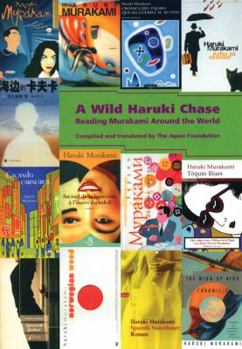
A Wild Haruki Chase: Reading Murakami Around the World


"Youthful, slangy, political, and allegorical, Murakami is a writer who seems to be aware of every current American novel and popular song. Yet . . . [ A Wild Sheep Chase ] is clearly rooted in modern... This description may be from another edition of this product.
Format:Paperback
Language:English
ISBN:193333066X
ISBN13:9781933330662
Release Date:April 2008
Publisher:Stone Bridge Press
Length:152 Pages
Weight:0.42 lbs.
Dimensions:7.5" x 0.4" x 5.3"
Customer Reviews
2 ratings
That Old Murakami Feeling
Published by Thriftbooks.com User , 18 years ago
A little more than three years ago when Haruki Murakami's thick novel Kafka on the Shore was released to both critical and popular acclaim, the grumbling of his fans grew almost as quickly as the novel raced up The New York Time's bestseller's list. A number of longtime fans seemingly felt that their hip, cool author was being discovered by the masses and their once clandestine literature was becoming popular fiction being read by everyone and their mom. However, if one looks outside of the English-speaking world where their seems to be more debate whom is Murakami's best translator, Alfred Birnbaum, Jay Rubin, or Philip Gabriel, instead of the quality of Murakami's fiction, one will notice that Murakami is more than a author loved by a select few, but a phenomenon, the Haruki Phenomenon, in and of himself. It is with this thought in mind that the symposium titled "A Wild Haruki Chase: How the World Is Reading and Translating Murakami" was formulated by a number of Japanese professors at the University of Tokyo and Meiji Gakuin University and Murakami's translators from four continents. The essays within the book are a select few from the symposium, but they give the reader viewpoints on how Murakami, and especially his novel Norwegian Wood, is received in various countries. Concerning South Korea, Murakami's translator Kim Choon Mie writes that Japanese literature was primarily limited world literature anthology collections before the appearance of Haruki Murakami because of the mutual feeling of antagonism shared between South Korea and Japan. Murakami's literature has become so popular in fact that Kim considers knowledge of Murakami Haruki to be a prerequisite for understanding South Korean literature because his themes and writing style have been emulated so much that it borders [...]. Similarly, Ivan Sergeevich Logatchov, Murakami's Japanese-Russian translator, states that Murakami has become so hip in Russia that young people prominently display their books to be sure that spectators are sure to see that they are reading Haruki Murakami and, like in South Korea, Murakami's impact on young Russian writers has been considerable, and Murakami, the first widely translated Japanese writer in Russia has become the measuring stick that other Japanese writers, including Ryu Murakami and Banana Yoshimoto, are measured against. Besides themes of how Murakami is popular in Russia, South Korea, China, Taiwan, etc., the authors also attempt to tell why Murakami has become popular enough to be translated into over thirty languages. Their primary answer is that like Murakami's protagonists, who live in an urban malaise fueled by a government who treats its citizens as a collective consumer group, mirrors the lives of citizens of other countries who have lost their ideals of being able to change their governments and to truly make an impact in this world. Instead they and we live in a world where materialist pursuits have come to represent individualit
"A great age of literature is perhaps always a great age of translations."
Published by Thriftbooks.com User , 18 years ago
Much is often made of Murakami Haruki and his novels as a worldwide phenomenon, and some mention of how many languages his novels have been translated into is part and parcel of just about any blurb about the author. And yet this short little volume is one of the first and only books (in English at least) to take this fact seriously as a subject of reflection in its own right. Based somewhat on some of the presentations given at a 2006 symposium hosted by the Japan Foundation, "A Wild Haruki Chase" consists of an enjoyably random selection of articles by various people variously involved with Murakami's fictional world--as translators, as fellow novelists, as scholars, as actors (in the film "Tony Takitani"), as reporters and amateur marketing analysts, and so on. As is common with books of this sort of format, the quality is also a bit randomly variable. Jay Rubin's introduction is nice, as deeply reflective as it is deceptively offhand and refreshingly facetious. Richard Powers offers some intriguingly thought-provoking and speculative meditations on Murakami's fiction, globalization, and the complexity of the human brain. Many of the other articles are interesting in their own ways, though sometimes perhaps a bit unpolished and loosely organized. That said, perhaps that's an advantage. Like Murakami's fiction itself, this casual, rambling style can startlingly open up into sudden insights and instructive perspectives--plus, some sense of the fun of such a symposium comes through therein. As per the book's theme, it also includes a wonderfully intriguing and colorful selection of illustrations featuring eighteen novel covers from around the world (France, Brazil, Spain, the United Kingdom, Italy, Romania, Croatia, Germany, Portugal, Denmark, Ukraine, Norway, Taiwan, China, Indonesia, Spain (Catalan), Korea, and Russia). I know, never judge a book by its cover, but still. Also a more usefully bibliographical list of the translations by country is also included at the end of the book. In short, for anyone who's enjoyed Murakami Haruki's novels and wants to know more about their much-alluded-to international reception, this is an enjoyably friendly glimpse into the topic--literary without being stuffy, and a nice quick read. Great for an afternoon in your favorite coffee shop. Articles included in this book: 1. "Introduction: The Murakami Aeroplain" by Jay Rubin 2. "To Translate and Be Translated" by Haruki Murakami 3. "Interpreting the Haruki Boom" by Inuhiko Yomota 4. "The Global Distributed Self-Mirroring Subterranean Neurological Soul-Sharing Picture Show" by Richard Powers 5. "What We Talk About When We Talk About Murakami" by Roland Kelts 6. "'Loss' in Murakami's Works and the 386 Generation" by Kim Choon Mie 7. "What Russians See in Murakami" by Ivan Sergeevich Logatchov 8. "Lu Xun and Murakami: A Genealogy of the Ah Q Image in East Asian Literature" by Shozo Fujii 9. "The Other Side of Happiness" by Issey Ogata 10. "Haruki Murakami as a
Copyright © 2026 Thriftbooks.com
Terms of Use | Privacy Policy | Do Not Sell/Share My Personal Information | Cookie Policy | Cookie Preferences | Accessibility Statement
ThriftBooks ® and the ThriftBooks ® logo are registered trademarks of Thrift Books Global, LLC
ThriftBooks ® and the ThriftBooks ® logo are registered trademarks of Thrift Books Global, LLC
