


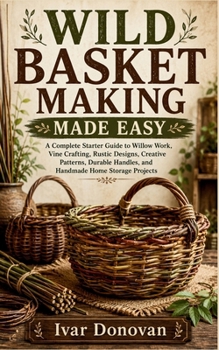
WILD BASKET MAKING MADE EASY: A Complete Starter Guide to Willow Work, Vine Crafting, Rustic Designs, Creative Patterns, Durable Handles, and Handmade Home Storage Projects
No Customer Reviews

Wild basket making is the art of turning natural materials from the environment into useful, beautiful, and meaningful handmade baskets. Unlike modern basketry that may depend on prepared craft supplies, wild basket making begins with what nature provides: vines, grasses, reeds, bark, roots, willow shoots, palm fronds, raffia, rushes, and flexible branches. For beginners, this craft is both practical and creative because it teaches you how to see ordinary natural materials in a new way. A vine hanging from a tree, a bundle of dried grass, or a young flexible stem can become part of a strong basket when it is gathered, prepared, and woven correctly. The beauty of wild basket making is that it does not require expensive tools or complicated machines. It is a slow, hands-on craft that connects you with natural materials and traditional skills. Many beginners are first attracted to basket making because the finished baskets are useful for storage, decoration, gardening, harvesting, or gift giving. However, the deeper value of the craft comes from the process itself. As you learn to bend, twist, weave, shape, and secure each material, you also learn patience, observation, and respect for nature. Wild basket making starts with understanding the character of each material. Some vines are strong and woody, while others are soft and easy to bend. Some grasses are best used when dried, while others must be soaked before weaving. Willow, for example, is loved by many basket makers because it is flexible, durable, and easy to shape when properly prepared. Reeds and rushes are also popular because they create neat, even patterns. Palm leaves and raffia can be used for lighter baskets, decorative weaving, and colorful finishing details. A beginner does not need to master every material at once. The best way to begin is by choosing one or two available materials and learning how they behave. One important part of wild basket making is learning how to gather materials responsibly. Since the craft depends on natural resources, it is important not to damage plants or collect more than you need. Responsible harvesting means taking only healthy, renewable growth and leaving enough behind for the plant to continue growing. It also means avoiding protected areas, private land without permission, or plants that may be rare, poisonous, or unsafe to handle. A good basket maker works with nature, not against it. For beginners, the first baskets do not need to be perfect. In fact, most early baskets may look uneven, loose, or slightly crooked. This is normal. Basket making improves through practice. The hands gradually learn how much pressure to apply, how tightly to weave, and how to shape the sides without forcing the material. Every basket teaches a lesson. A loose basket teaches you about tension. A basket that leans teaches you about balance. A cracked material teaches you about soaking, flexibility, and preparation.
Format:Paperback
Language:English
ISBN:B0H2XLF8GT
ISBN13:9798198371873
Release Date:May 2026
Publisher:Independently published
Length:148 Pages
Weight:0.34 lbs.
Dimensions:8.0" x 0.3" x 5.0"
Customer Reviews
0 rating
Copyright © 2026 Thriftbooks.com
Terms of Use | Privacy Policy | Do Not Sell/Share My Personal Information | Cookie Notice | Cookie Preferences | Accessibility Statement
ThriftBooks ® and the ThriftBooks ® logo are registered trademarks of Thrift Books Global, LLC
ThriftBooks ® and the ThriftBooks ® logo are registered trademarks of Thrift Books Global, LLC
