


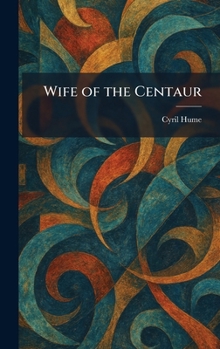
Wife of the Centaur

"Wife of the Centaur" is a poignant exploration of the post-World War I "Lost Generation," capturing the restless spirit and moral ambiguity of 1920s youth. This evocative novel delves into the internal conflict of Jeffrey Dwyer, a talented young poet whose dual nature-the refined intellectual and the impulsive, carnal "Centaur"-threatens the stability of his domestic life.
As Jeffrey navigates the vibrant and often superficial social scenes of the Jazz Age, he finds himself perpetually torn between his sincere devotion to his wife, Joan, and the intoxicating, destructive allure of sudden passion. Cyril Hume's narrative serves as a sophisticated psychological study of the artistic temperament, illustrating the struggle to reconcile wild, animalistic instincts with the constraints of social expectation and fidelity.
Through lyrical prose and sharp observation, "Wife of the Centaur" provides a vivid portrait of early 20th-century American society. It remains a significant work of its era, offering a timeless meditation on the complexities of the human heart and the search for authentic connection in a world of shifting values.
This work has been selected by scholars as being culturally important, and is part of the knowledge base of civilization as we know it. This work was reproduced from the original artifact, and remains as true to the original work as possible. Therefore, you may see the original copyright references, library stamps (as most of these works have been housed in our most important libraries around the world), and other notations in the work.
This work is in the public domain in the United States of America, and possibly other nations. Within the United States, you may freely copy and distribute this work, as no entity (individual or corporate) has a copyright on the body of the work.
As a reproduction of a historical artifact, this work may contain missing or blurred pages, poor pictures, errant marks, etc. Scholars believe, and we concur, that this work is important enough to be preserved, reproduced, and made generally available to the public. We appreciate your support of the preservation process, and thank you for being an important part of keeping this knowledge alive and relevant.
Customer Reviews
ThriftBooks ® and the ThriftBooks ® logo are registered trademarks of Thrift Books Global, LLC
