


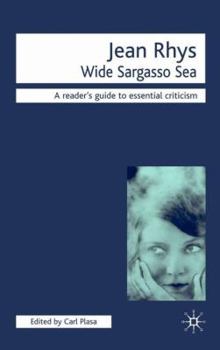
Jean Rhys - Wide Sargasso Sea


In this Reader's Guide, Carl Plasa provides a comprehensive survey and analysis of the most stimulating critical responses to Wide Sargasso Sea. The opening chapter outlines initial reactions to the novel from English and Caribbean critics, charting the differences between them. Chapter Two explores Wide Sargasso Sea's dialogue with Jane Eyre and the theoretical questions it has raised. Succeeding chapters examine how critics have assessed the racial politics of Rhys's text, discuss the novel's African Caribbean cultural legacy, and explore how critics read the work both in terms of its moment of production and the early Victorian period in which it is set. Throughout, Plasa contextualizes and clarifies the critical exchanges which this daring and dramatic novel has provoked.
Format:Paperback
Language:English
ISBN:184046268X
ISBN13:9781840462685
Release Date:November 2001
Publisher:Red Globe Press
Length:176 Pages
Weight:0.54 lbs.
Dimensions:0.6" x 5.5" x 8.5"
Customer Reviews
3 ratings
Uncanny and vividly intense
Published by Thriftbooks.com User , 18 years ago
In "Wide Sargasso Sea", Jean Rhys offers the reader another side to "Jane Eyre". The story of Bertha, the first Mrs Rochester, "Wide Sargasso Sea" is a damning history of colonialism in the Caribbean. The story is set just after the emancipation of the slaves, in that difficult time when racial relations in the Caribbean were at their most tense. Antoinette is descended from plantation owners. She can be accepted neither by the black community nor by the representatives of the colonial centre. As a white Creole she is nothing. The taint of racial impurity, coupled with the suspicion that she is mentally imbalanced bring about her downfall. Rhys divides the speaking voice between Rochester, who is never named in the novel and Antoinette. Rochester is portrayed a proud younger brother betrayed by his family into a loveless marriage. His double standards are exposed when he chooses to sleep with the maid, Amélie, so displaying the promiscuous behaviour and attraction to the black community which he accuses Antoinette of harbouring. Their happiness at Granbois is ended by his willingness to believe the worst of Antoinette. The lack of understanding between two cultures is at the root of Antoinette's subsequent madness. Madness for Antoinette mostly derives from the uneasy feeling of being unable to tell the difference between dream and reality, when reality eventually becomes dream-like. The book is read by Anna Bentinck for ISIS Publishing. An impressive performance given the wide range of accents used by the reader.
The horror... the horror... Wide Sargasso Sea is a searing indictment
Published by Thriftbooks.com User , 18 years ago
Jean Rhys' Wide Sargasso Sea is a dreamlike feverish novel awash in passion and trauma. Forget for a moment that it's a sequel to "Jane Eyre" or that it is a seminal text in Feminism and Colonialist studies. Simply as a strikingly modern story of trauma and madness it is brilliant. Disorienting, agonizing, nightmarish yet stunningly beautiful; I was forced to read it in dribs and drabs - as the knife edge of Rhys' vision would compel me to come up, panting for air. This book is powerful - yet unforgivingly dark. But, of course, it is much more - it's a modernist masterpiece which brilliantly critiques the human costs of crimes of patriarchy, colonialism, slavery and subjugation. It is a searing indictment at the same time it is a haunting work of art. Antoinette grows up poor and isolated at her family's plantation. Her companions are the black laborers and their children who simmer with resentment at the legacy of slavery. Slavery may have been abolished but has been replaced with economic and social subjugation and the resentment is palpable. Mr. Mason disregards this in a classic example of colonialist arrogance - which destroys their lives. Her mother's anger at Mr. Mason leads to her imprisonment as a mad woman. Women are not permitted to express rage. Patriarchy is central because Antoinette/Bertha is chattel. Her marriage to Rochester is effected because she owns land - it's an economic arrangement to gain property for Rochester. Once married, Antoinette/Bertha is stripped of all her claim to property and is completely under her husband's authority. Their marriage is marked by passion but it becomes apparent how culturally Caribbean (black) she is, tainted with scandal. Their relationship flames out spectacularly. When he decides he can't deal with her and chooses to abandon her to be locked as "the madwoman in the attic" she is reduced to, essentially, a prisoner. A woman, in that society, is literally the prisoner of her husband. Both Antoinette and her mother, Bertha are confined as mad - but their pathologies are the simple act of blaming their spouses and acting out their anger. Rebellion is seen as madness - both in the context of rebellion against slavery and rebellion against patriarchy. As for the literary context - "Wide Sargasso Sea" as sequel to "Jane Eyre". By situating WSS's story within the classic Victorian novel "Jane Eyre", Rhys sets up a host of powerful resonances. Jane Eyre is a tale of redemption; of love's power to redeem. England's brutal social and economic inequities are hurdles to be overcome - but ultimately love overcomes them all in a healing and redemptive way. The fly in the ointment is Bertha, the mad woman in the attic. Her presence complicates the otherwise straightforward romantic narrative and gives it tension and fire. By inverting this tale to tell the story of Antoinette/Bertha, Rhys deepens the misery by shattering "Jane Eyre"s redemptive message. In "Wide Sargosso Sea"
"I feel bolder, happier, more free. But not so safe."
Published by Thriftbooks.com User , 19 years ago
Haunting and resonant, Wide Sargasso Sea evokes and era and place, mid-nineteenth century, with an almost hallucinatory beauty, a remote Caribbean island near Jamaica, a lonely young woman abandoned to her unwilling caretakers, forever searching for a safety that does not exist. The once powerful Creole family has fallen into desperate times, the profligate patriarch dead from his own excesses, his beautiful second wife, Annette, left to suffer in isolation with her two children, the small son impaired developmentally, and the daughter, Antoinette Cosway, emotionally damaged by a distant mother. A recently emancipated slave society is no longer willing to suffer the conceits of their former masters. As the islanders become more hostile, the newly remarried Annette Cosway berates her groom for his inadequacies in protecting them, losing contact with reality after losing her frail son, the victim of an incident with the former slaves. Antoinette Cosway grows into womanhood a beauty like her mother, but an inherited fortune renders her a pawn of fate. Given by her guardian in marriage to the penniless Mr. Rochester (of Jane Eyre fame), Antoinette finds no solace in the arms of a man who does not love her, indeed, hardly knows her. For a time, the transports of physical passion are sufficient distraction, but, like island life, even pleasure is exhausting, burning out in its own brilliance. Convinced her husband no longer loves her, Antoinette seeks aid from her former nanny, Christophine, an obeah woman who attended her mother in days past. Decay is pervasive on an island where the sun shines too intensely, Antoinette retreating to the fevered images of her imagination in lieu of the happiness she was promised. These two worlds cannot amicably coexist, Rochester longing to escape his terrible bargain, Antoinette clinging to the remnants of her dignity and disordered mind. Finally, the madwoman in the tower loses the only reality sustaining her, shut away from the world in an unforgiving climate of disinterest, banking the cold fires of a new hell in England: "This cardboard house where I walk at night is not England." Drawing from her personal knowledge of the West Indies and the unfortunate Creole heiresses of the times, Rhys reveals the decadent, incestuous societies in which such women flourished, resented by the former slaves, ripe for the plucking from their exotic vines. The truth lies somewhere between the perspectives of Antoinette and Rochester, an odd blending of cultures inspired by the easy fortunes to be plundered in a society where women are irrelevant. Hypnotic and disturbing, Antoinette Cosway's tortured existence is a stunning indictment of an indifferent society, even Rochester victimized by the constraints of honor and propriety. Luan Gaines/2006.
Copyright © 2026 Thriftbooks.com Terms of Use
| Privacy Policy | Do Not
Sell/Share My Personal Information | Cookie Policy | Cookie Preferences | Accessibility Statement
ThriftBooks® and the ThriftBooks® logo are registered trademarks of Thrift Books Global, LLC
ThriftBooks® and the ThriftBooks® logo are registered trademarks of Thrift Books Global, LLC
