


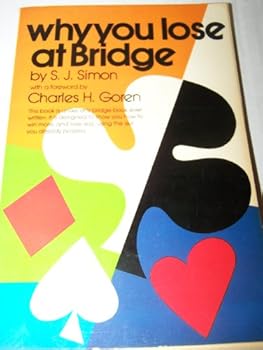
Why You Lose at Bridge

Select Format
Select Condition 
Book Overview
No Synopsis Available.
Format:Paperback
Language:English
ISBN:0346123100
ISBN13:9780346123106
Release Date:January 1977
Publisher:Simon & Schuster
Length:160 Pages
Weight:0.54 lbs.
Customer Reviews
5 ratings
Why You Lose at Bridge - a true evergreen
Published by Thriftbooks.com User , 18 years ago
WHY YOU LOSE AT BRIDGE is a true evergreen. Read it once when you are a beginner. It is truly hard to find such concise guide how to advance rapidly from the basics. Or, like me - after all it first appeared before I was born - rediscover it if you want to improve faster. Players at all levels will find something fresh and stimulating while reading it. Many books dwell for long pages on the intricacies of the complex game of bridge, but this book really focuses on the essentials, on how to think at the bridge table, and how to remain realistic, especially if you are playing with different partners. And if you have an established partnership, read it together. Walking the fine line between being too aggressive or too conservative is the key to success in bridge, and this book has good advice on how to fine-tune your approach. The pages on competitive bidding are pure gold. The reader will find practical gems like dealing with preempts and psychic bids or playing 4-3 fits - just to name a few - which are as important to the matchpoint and team players today as they were for rubber bridge in the forties. To wrap it up, read and re-read it! And it's fun, the characters are memorable and the boards excellent and thought provoking.
This book proves "unlearning" as important as learning for any bridge player
Published by Thriftbooks.com User , 18 years ago
The bridge-bidder's arsenal is usually full of "gadgets": non-literal bids meant to convey or suggest information that might escape the normal bidding sequence. Even by the time this 1940s book appeared, "scientific" systems by leading bridge "experts" were all the rage. Who would disagree with scientific "experts"? After all, you can't fight progress. WHY YOU LOSE AT BRIDGE dares to differ. S.J. Simon, author of this enduring little volume, shows us the genuine odds behind competitive bidding and play and explains things the highly regarded experts of his day didn't know -- or didn't want us to know. [Note: the following two grafs assume some bridge experience.] Would you almost automatically double a competitor's bid of "Six Spades" (12 of the 13 card tricks) if you had two "quick tricks" in your hand? Think about it, Simon warns. If the opponents have even a one-in-three chance of winning, your unthinking double will give them between four and six times the number of points for making contract considering vulnerability. Besides, when they hear your double the declarer will figure you for the two Aces and act accordingly. Watch out for the sure things that really aren't. And sometimes (usually, the author implies) the scientific gadgets aren't worth it. At one tourney, following tortuous symbolic bidding, one partnership came to a contract of four spades and went down one. How had the author and his partner bid that "impossible" hand? Like this: South - 1 NT; North - 3 NT. Simple and literal. After offering a bracing immersion in what I all "unlearning," Simon spends the second half of the book on the psychology of bridge, starting with the times a partner or opponent starts what he calls "trancing" -- mulling things over. Chapter Eleven, "The Logic of Luck," typically illustrates Simon's curmudgeonly attitude. We could almost blame him for the high-British-arch tone of his writing, except that he is always right! WHY YOU LOSE AT BRIDGE is a tremendous book for bridge beginners, perhaps even more so for intermediates and even the more experienced players trying to cope with a new partner. Of course, this WAS the 1940s so the author assumes that major suits (Hearts and Spades) can be bid upon with only four of them in hand as opposed to today's more prevalent "five-card major" approach. And I have to wonder what Simon would make of today's bidding in general.
The Best Advice on Becoming a Better Partner
Published by Thriftbooks.com User , 24 years ago
S. J. Simon's Why You Lose at Bridge remains (since its original 1945 publication) the best text on improving one's partnership available anywhere at any price. Read it. Practice what you learned. Watch your partnerships improve. Read it, again ...If you have a standing partnership, read it together. Even the most capable professionals may well (re)discover ways to improve their game as they absorb Simon's words of wisdom. Improve your partnership, and your game improves. Simon sez ...
One of the greatest bridge classics.
Published by Thriftbooks.com User , 27 years ago
Skid Simon writes about club bridge, and how to deal with various partners. We kibitz a rubber among Mrs. Guggenheim, The Unlucky Expert, Mr. Smug, and Futile Willy. A loong rubber. A reasonable player in any of the seats would have won the rubber for his side. Bidding is British style, but what the heck... The truth of the book is eternal, and the style sparkles with humor.The essence: play for the best result possible with this partner, not the best possible result.
Still the best bridge book I have ever read.
Published by Thriftbooks.com User , 28 years ago
Written long ago, but by no means out of date, this book describes the major ways that average players achieve less than they could.The first half of the book describes common technical errors and how to learn to avoid them: the second half describes common personality types and how to minimize their destructiveness as your partner. At the end is the reproduction of a rubber in which many common mistakes were made.The book is a wonderful combination of instruction and humour.
Copyright © 2026 Thriftbooks.com
Terms of Use | Privacy Policy | Do Not Sell/Share My Personal Information | Cookie Policy | Cookie Preferences | Accessibility Statement
ThriftBooks ® and the ThriftBooks ® logo are registered trademarks of Thrift Books Global, LLC
ThriftBooks ® and the ThriftBooks ® logo are registered trademarks of Thrift Books Global, LLC
