


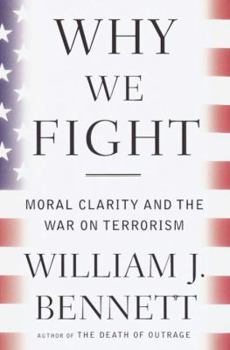
Why We Fight: Moral Clarity and the War on Terrorism

Select Format
Select Condition 
Book Overview
The events of September 11, 2001, were an unforgettable tragedy, but they also revealed that the spirit of America is strong and undiminished. Not since the shocking attack on Pearl Harbor has the... This description may be from another edition of this product.
Format:Hardcover
Language:English
ISBN:0385506805
ISBN13:9780385506809
Release Date:April 2002
Publisher:Doubleday
Length:170 Pages
Weight:0.70 lbs.
Dimensions:8.5" x 0.7" x 5.7"
Customer Reviews
4 ratings
A moderate and well-written essay
Published by Thriftbooks.com User , 21 years ago
Let's try to judge this book on its merits. I just voted for Kerry for President, and while he got plenty of votes, he still lost. I read this book without judging the author on his politics or his gambling record. We Americans were attacked by thugs on September 11, 2001. That put us at war, whether we wanted to admit it or not. Whether we fought back or not, we were still in a war. And this book is something of a pep talk for us as we try to take proper action. Bennett's first topic is pacifism. He makes the point that at some point, those who refuse to fight are putting their fates in the hands of those who do fight. And, of course, he points out that some so-called pacifists are simply using that term as a cover for anti-Americanism: saying you are a pacifist does not guarantee that you are one. The next issue deals with the fact that we have an enemy. Bennett shows that we have to regard those who attack us as our enemies. The question is how to define that group. Is it all radical anti-American Islamists? All Arabs? All Muslims? If we pick too narrow a group, we're letting our enemies join our alliance. If it is too large a group, we're alienating and attacking our friends. Bennett shows the core of the problem: those groups who are truly extreme automatically try to confuse the issue by saying that in going after them, we're being unreasonable, xenophobic, Islamophobic, and racist. And that in fact some groups that purport to represent many American Muslims, including the American Muslim Council (AMC) and the Council on American-Islamic Relations (CAIR) have defended or supported the terrorist groups Hezbollah and Hamas. I think he's making an excellent point here: we need to know where to draw the line. Bennett also discusses a potential consistency problem we face: can we truly oppose terrorism and at the same time declare our determination to help create a state for Yasir Arafat, whom Bennett refers to as "simultaneously a terrorist himself, an instigator of terrorism, and a supporter and harborer of terrorists?" No, we can't. Bennett does a good job of explaining the terrorist attacks on Israel and the folly of appeasement with regard to them. A final issue Bennett takes on is the reaction to patriotism in our universities. And his issue here turns out to be academic freedom. That greatly surprised me. I had expected Bennett, of all people, to take risks with our freedoms in order to fight the enemy. But he didn't. Instead, he merely advised us to be careful about having one of our best universities accepting funds (with strings attached) from the bin Laden family. And said that it might be a good idea for Harvard to restore giving credit for ROTC classes. Bennett may not have a reputation as a moderate, but in this book, he took a very moderate and inclusive stance. If you read this book, I think you'll notice that.
True Clarity
Published by Thriftbooks.com User , 22 years ago
I also wonder why our so called intellectuals have problems with patriotism. I Emailed Mr. Fish in regards to his stand and received back a razored reply and a disregard to Mr. Bennetts book and statements. Our country cannot survive without the complete patriotism that was in the past. The more we allow these denizens of America to cry and forgo all we have stood for in our past history the closer we come to the fall of our great country. The only thing I sincerly feel is after 9/11 we saw a lot of our young for the first time feeling the tear jerking, heart swelling pride that comes with being a American, this our so called intellectuals cannot pull away from our young. A great book and will continue to read more of Mr. Bennetts writings.
Bennett is at his best with this release!
Published by Thriftbooks.com User , 23 years ago
Over the past several months America's involvement in Iraq has created a stir throughout the entire nation. One thing that has presented itself over the past several months is the question of why we are involved in Iraq. William Bennett has tackled this question with this book. Bennett has certainly laid out a foundation of reason for the need to take on those that pose a threat to national security and those that use terrorist tactics to destroy. Bennett pulls no punches as he skillfully draws the picture that patriotism is stronger now than ever. He brings out the strongest arguments to show that sitting back and waiting can only lead to further disaster. Bennett's arguments are rationally discussed and the positively backed up with evidence. Bennett takes on both side of the argument, showing we the administration has failed and where is has been strong. Overall, whether you like Bill Bennett or not, keeping an open mind while reading this book will certainly show you a few new things and open you up to new ideas. So whether you are liberal or conservative, Democrat or Republican, this book does shed new light on what makes this country what it is today - great!
Speaking Truth to Power
Published by Thriftbooks.com User , 24 years ago
Why is it that so many intellectuals and media-elites are uncomfortable with patriotism? Why do they fail to recognize that, despite its flaws, America remains a beacon of freedom to the oppressed and downtrodden around the world? And why do the elites cheer on America's enemies as those enemies seek to extinguish the rights that enable us to speak our minds, criticize the government, and determine our own destinies? Bill Bennett tackles these nagging questions, and more, in his excellent short book "Why We Fight."Bennett also explains the moral, philosophical, and theological justifications for using force to avert evil. He respectfully and thoughtfully examines the underpinnings of various strains of pacifism, and describes how many pacifists, including some Quakers, have come to recognize that there are times when force is not only justified, but required.In the end, the explanation of why we fight is easily understood. We fight to preserve freedom's foothold against the forces of tyranny and despotism. America's moral failings, including slavery, are the exception rather than the rule. Those who do not understand that will never understand this book, and deserve our pity rather than our contempt.
Copyright © 2026 Thriftbooks.com
Terms of Use | Privacy Policy | Do Not Sell/Share My Personal Information | Cookie Policy | Cookie Preferences | Accessibility Statement
ThriftBooks ® and the ThriftBooks ® logo are registered trademarks of Thrift Books Global, LLC
ThriftBooks ® and the ThriftBooks ® logo are registered trademarks of Thrift Books Global, LLC
