


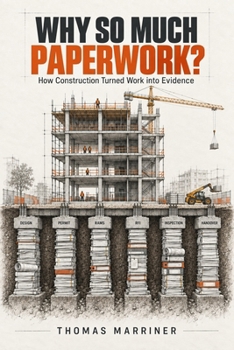
Why So Much Paperwork?: How Construction Turned Work into Evidence

Why does modern work generate so much paperwork?
A permit before the job starts. A photograph before the work is covered. A notice before a contractual right is protected. A programme update, an inspection record, a handover file, a mandatory field nobody can quite explain.
Construction is full of paperwork. But what if the real story is not bureaucracy?
In Why So Much Paperwork?, Thomas Marriner follows the paperwork backwards. Where did it come from? Who actually requires it? What problem was it designed to solve? Why does so much of it end up with the main contractor? And how do we tell the difference between evidence that genuinely matters and administration that has simply learned how to survive?
The answer reaches far beyond construction.
Modern organisations increasingly have to prove what they did, what they knew, what they checked, who approved it and what should happen next. Work is no longer only performed. It is recorded, verified, audited and preserved for people who were never there.
This book explains how physical work became evidence infrastructure: drawings, permits, inspections, qualifications, notices, certificates, digital workflows, approvals, asset data and records that allow people to trust work they did not personally see.
You will discover:
- why the idea that builders once "just built things" is a myth;
- how the modern main contractor became a documentary junction where requirements travel out and evidence comes back;
- the difference between what the law actually requires and the forms, templates and systems organisations choose to create;
- why contracts, quality assurance, competence schemes, client requirements and management systems create different kinds of paperwork;
- why permits, concealed-work inspections, notices and handover information can be among the most valuable records on a project;
- how BIM, common data environments and digital platforms can reduce paperwork while creating more recorded information;
- why the same fact can end up in several systems, and when that is useful translation rather than pointless duplication;
- why buildings need an institutional memory, and how building safety and the Golden Thread make lifecycle information important;
- and how to decide whether the next form, field, upload, approval or record should be protected, simplified, reused or retired.
At the centre of the book is one deceptively simple question:
What does the next record buy?
That turns a familiar complaint into a practical way of thinking about bureaucracy, compliance and administrative burden.
Why So Much Paperwork? is for site and project managers, quantity surveyors, designers, consultants, subcontractors, developers, clients, facilities teams, procurement professionals, quality and health-and-safety specialists, commercial teams and anyone involved in delivering or operating buildings.
But it is also for anyone outside construction who has ever wondered why modern organisations turn one piece of work into five systems, three approvals and a trail of evidence.
If you work in a regulated industry, manage complex supply chains, or deal with audits, compliance, quality assurance, digital workflows or organisational bureaucracy, much of this story will feel familiar.
It is about understanding why it exists well enough to know what should survive.
Some paperwork protects people. Some protects money. Some protects knowledge. Some allows strangers to trust each other. Some exists because the work will soon be hidden forever.
And some of it is simply friction.
Before complaining about the paperwork, ask why it exists.
Before defending it, ask whether it still answers the question.
Customer Reviews
ThriftBooks ® and the ThriftBooks ® logo are registered trademarks of Thrift Books Global, LLC
