


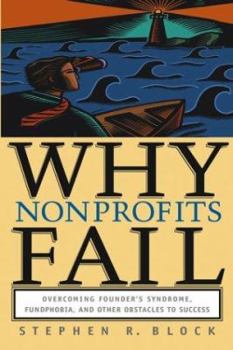
Why Nonprofits Fail: Overcoming Founder's Syndrome, Fundphobia, and Other Obstacles to Success

Select Format
Select Condition 
Book Overview
In Why Nonprofits Fail, author and nonprofit expert Stephen Block explains that many well-intentioned leaders hold on to views of their nonprofit organizations that perpetuate problems rather than help fix them. According to Block, the first step to success is to challenge one's own personal paradigms and ideas and be open to unique and alternative approaches to solving problems. This much-needed book helps nonprofits get back on track and offers advice about the seven most common stumbling blocks, including: Founder's syndrome Fundphobia Financial misfortune Recruitment disorientation Cultural depression in nonprofit organizations Self-serving political performance Role confusion between the board and executive director
Format:Hardcover
Language:English
ISBN:0787964093
ISBN13:9780787964092
Release Date:December 2003
Publisher:Wiley & Sons, Incorporated, John
Length:208 Pages
Weight:0.87 lbs.
Dimensions:0.8" x 6.3" x 9.1"
Customer Reviews
2 ratings
Founders Syndrome....
Published by Thriftbooks.com User , 17 years ago
If the founders at your organization are making you crazy and will not let anyone else take over leadership, even as they are driving the place in the ground or just holding it still by slamming on Founders' Brakes, then you should read this book and google FOUNDERS SYNDROME. It will help you and your colleagues "get" what is going on....seriously....
Don't fail to read this book
Published by Thriftbooks.com User , 20 years ago
Stephen R. Block provides essential information for anybody thinking about forming a non-profit corporation. Good intentions will quickly get drowned unless a LOT of thought and advance planning guides your non-profit organization from idea inception into founding and daily operations. Contrasting with the cash-rich image of politics, the non-profit world is under girded by frugality and this is especially true for the start up non-profit organization. It must work to establish itself as both an effective and viable resource in communities which might have already-established non-profit organizations performing identical functions. How does the newcomer organization work better than predecessors? Why is supporting the newcomer organization a better choice for people? Starting and then successfully running a non-profit organization requires a LOT of work. It is emphatically NOT something people should do because they are bored or looking for public adoration. In addition to organization structure, founder psychology is an essential component to non-profit organization viability. Boosting your organization certainly is essential to building its reputation, but cannot be done at the expense of (less-glamorous) long-term planning and idea sharing. How will the organization implement programs? What programs will be implemented versus what programs are not? Furthermore, a founder considering the organization "theirs" consequently will have a difficult time conceding when those ideas are ineffective or even detrimental to organizational affectivity. However well-intentioned, some founders do not know when to ask for help or when the organization really needs it. This stalling consequently jeopardizes organization efficacy and longevity. Unable to fulfill original intentions, the organization subsequently folds while conversely the problem it was supposed to address remains. Early critical missteps ultimately give non-profit start-ups a very short future. Block is a recognized expert in this field, but his real genius comes from wanting theories readily applicable to field practitioners, the start-up non-profits themselves. He actually intends this book to help people avoid all-too-common pitfalls in starting up and then running a non-profit organization. I read this book after having worked at a start-up community organization ultimately unable to complete proposed projects despite good initial intentions; our organization subsequently lasted under a year. Block's `founders syndrome' chapter described the situations I had experienced with perfect clarity. I was also reassured the organization's ultimate failure was not a value judgment on me personally and our missteps happen to many other honestly-well intentioned people who also do not realize what starting up and successfully running a non-profit requires. The first couple of years are especially critical because they establish a non-profit as an essential community resource or a fla
Copyright © 2026 Thriftbooks.com
Terms of Use | Privacy Policy | Do Not Sell/Share My Personal Information | Cookie Policy | Cookie Preferences | Accessibility Statement
ThriftBooks ® and the ThriftBooks ® logo are registered trademarks of Thrift Books Global, LLC
ThriftBooks ® and the ThriftBooks ® logo are registered trademarks of Thrift Books Global, LLC
